Showing posts with label books. Show all posts

Tuesday, June 4, 2013

Book sale justice

Jamie and I took a trip to Metcalf South Shopping Center tonight for the annual Johnson County Library Used Book Sale. It's awesome - seriously, check it out. It's the best used book sale in Kansas City, and it's going on all week.

After a few minutes at the sale, we noticed one of the things we despise most: poachers.

What are poachers? If you've been to a used book store, a thrift store or a used book sale in the past few years, you've probably seen one. They have little barcode scanners attached to their smart phones, and they scan each and every book they run across to see if they can make a profit by selling it online.

To put it plainly, these people are assholes. I hate them. If you are one, I hate you. What those people do is not illegal, but it's annoying an immoral as hell, in my opinion. Book sales are for people who love books; people who come in and take all the best ones simply to resell them at a profit are despicable human beings. They don't care about the books they're scanning; in fact, they generally don't look at anything except for the barcode.

Pictured: the hand of an asshole.

The poachers were out in force tonight at the book sale. They were working in teams; I saw three women who were connected to each other via bluetooth headset, talking over strategies wirelessly. All the poachers carted their finds around in big wheeled carts that, of course, blocked the stacks of books from the regular people who were just looking for good things to read. And they were aggressive, too; pity the poor soul who gets in between them and a table of potential profit.

Jamie and I shopped around for about an hour, then before exiting we found a bench and sat down to take stock of our selections and weed out the ones we really didn't want after all. We ended up with a stack of four or five books in a discard stack.

Before Jamie had a chance to re-shelve the books, I stopped her. I saw a poacher in front of us and I was struck with inspiration. I laid out my plan to Jamie, and we executed it brilliantly.

The poacher was scanning a table of books and had started to wander away from her cart. When the space between her and her cart got big enough, I stepped between the two. Jamie swiftly came in behind me and gently placed our leftover books in the poacher's cart, then walked off. When the poacher turned around and noticed I was between her and the cart, I apologized and walked away in the opposite direction.

We met up a few minutes later and high-fived.

The beauty of our revenge mission was that the poachers don't actually look at the books they scan, so she probably never noticed our books in her cart. When she gets home and scans the books again to post them on Amazon or eBay or wherever, she'll be confused as hell wondering why she put those books in her cart. Heck, maybe the four or five bucks we cost her will make her reconsider whether it's a profitable venture. Probably not, but a boy can dream.

As I said earlier, these people are completely within their rights to poach at used book sales. And I feel like I'm within my rights to screw with them. I have zero remorse, and I would happily do it again.

In fact, if you're a poacher, and I run across you at a book sale, don't be surprised if you end up with a few duds in your basket.

Tuesday, May 8, 2012

Book recommendation: "Blue Monday"

I stumbled upon a little gem in the Half Price Books clearance section recently, a novel called "Blue Monday" by a Missouri author named Harper Barnes. Although Barnes is from St. Louis, "Blue Monday" is all about Kansas City, baby, when Kansas City was the place to be - the mid-1930s.

The novel gives a fictionalized account of a real historical event, the suspicious death of band leader Bennie Moten, who died on an operating table in KC during a simple tonsillectomy. The main character is a white reporter at a third-rate Kansas City newspaper who frequents in the African-American wonderland that was 18th and Vine, where Moten and other jazz legends, including Charlie Parker, Big Joe Turner, Count Basie and dozens more, cut their teeth. The book also takes place during the time of gangster Johnny Lazia, developer J.C. Nichols and Senator Harry Truman, who all contribute to the back story, and hanging above it all is the ever-looming presence of Tom Pendergast, who pulls the strings from City Hall to Ward Parkway to 18th and Vine and all points in between.

I've tried to read the Pendergast biography "Tom's Town," but I couldn't slog through it. (I bought it for nearly forty dollars to try to impress a girl. I guess it worked. We've been married almost nine years. That's a story for another time.) Maybe I'll pick up "Tom's Town" again down the road. But for now, "Blue Monday" is giving me a realistic and vivid insight into Kansas City history.

If you can find a copy of the short-print novel, published in 1991 by a local press, buy it. The link above is to the Amazon page for the book. Here's a good start to a soundtrack for your reading experience.

Monday, November 21, 2011

An excellent anecdote - and antidote - for starving writers

As I watch the Chiefs play (surprisingly) decent football against the New England Patriots, I am also reading a collection of boxing short stories by F.X. Toole. The collection, published in 2000 under the title "Rope Burns," but since then it's been re-named after its most famous short story: "Million Dollar Baby."

I haven't reached the well-known tale just yet, but I was intrigued by the introduction. Toole, a former boxer, trainer and corner man, for years worked to break into the writing biz. He accomplished it with this story collection in 2000, but sadly passed away just two years later. This is the best boxing fiction I've read outside of W.C. Heinz' classic "The Professional."

Here's a brilliant passage from the introduction comparing Toole's two passions, which should ring true to all you aspiring writers out there hoping to make money at it someday.

I started in the amateurs, took nights off from my job so I could work three-rounders in VFW halls, recreation centers, and the back rooms of spaghetti joints. Then four-rounders, and ten, and traveling around the world to work twelve-round title fights. I've worked seven title fights of one kind or another, and I've been licensed in ten states - from Hawaii to New York, from Missouri to Florida. There are plenty of guys who have done much more in boxing than I, but there are many who've done less. And I've fought in Mexico, France, Germany and South Africa - where, in Cape Town, by the way, they produce a champion Cabernet Sauvignon, Fleur de Cap, that will do wonders for your spirit.


About the only thing I haven't done in boxing is make money. It's the same for most fight guys. But that hasn't stopped me any more than not making money in writing has. Both are something you just do, and you feel grateful for being able to do them, even if both keep you broke, drive you crazy, and make you sick. Rational people don't think like that. But they don't have in their lives what I have in mine. Magic. The magic of going to wars I believe in. And the magic of boxing humor, the joke almost always on the teller, that marches with you every step of the way.

Monday, June 20, 2011

Will Ferrell may introduce more young writers to Raymond Carver and the guy with all his furniture out on the front lawn: Everything Must Go


The very idea of a guy drinking whiskey and looking out on his front lawn where he has trotted out all the furniture of his former life for a sort of crazy man's yard sale, gets my writing blood up.

So much so that I've shared the origin of the idea with many of my writer students across the years. It is inevitable the best students will wander into my office, sit down underneath Albert Einstein, and want to talk about writing. Often, they are discouraged. College can be discouraging to writers. It is full of criticism and -- boy, I hate to say this -- literature they often find remote, and the pleasure they feel in putting words together becomes more mathematical than joyful.

Often they are searching for themselves at the same time they are searching for clues to a writing life. Tough in spades.

About half the time, the conversation starts with a question. "Do you know anything about Kerouac?" Or, "I just started Kerouac..." which is also a question without a question mark. Or, "Do you have On the Road?"

I've gone through a half-dozen copies of On the Road. For some reason I never get them back despite the warning my father always gave me when he loaned a tool: "Son, don't forget where you got that."

I usually warn them, too, about how Kerouac died. They nod, but they don't listen. They're young.

Then I try to turn them on to Henry Miller (Tropic of Cancer is out on loan...) or Clyde Edgerton (Rainey, for those about to embark on marriage...). And always I tell them about Raymond Carver. When I do, I tell them about the man drinking whiskey with all his possessions on the front lawn.

They look at me like maybe I've finally gone around the bend.

Now they have the opportunity to see the story. Will Ferrell stars in a new film titled Everything Must Go, which is based on the Carver story "Why Don't You Dance?". Perhaps the film will lead them to Carver, then to the collection "What We Talk About When We Talk About Love." I hope so.

I ordered copies just in case.

--Lofflin

Friday, August 20, 2010

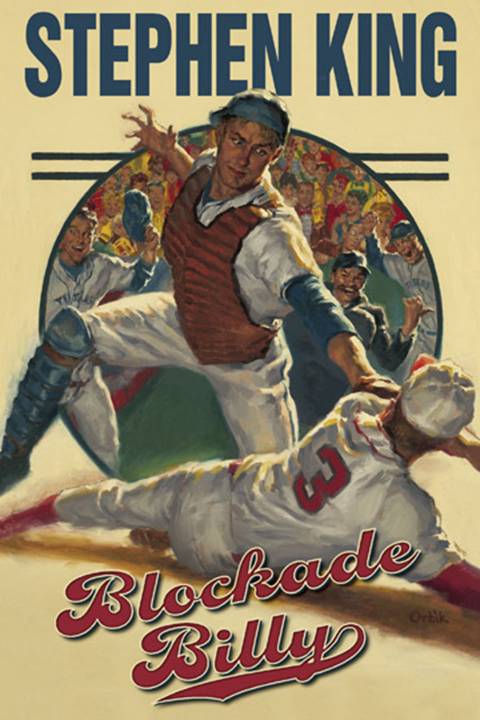
Book Review: "Blockade Billy"

As always, I feel hesitant to post because I'm afraid I'll push one of John's brilliant posts to the backburner.

But he would tell me to just shut up and write. And I've been holding off on this post too long. So, here goes...

Stephen King has written a nicely disturbing novella in "Blockade Billy." Although it's chock-full of homespun baseball cliches, in the vein of "The Great American Novel" although not done as well, "Blockade Billy" hits its stride at the end, when it stops being a baseball story and becomes a Stephen King story.

Unfortunately, the two can't coexist.

King is not very good at writing about baseball.

But that's okay. He's good at scaring the bejeesus out of you, and he's good at making the hairs stand up on the back of your neck (across all mediums in a way NOBODY else can), and he's good at turning a nice, cute little story into a twisted tale of murder and horror.

This is actually King's second (at least) attempt to incorporate baseball into a horror story. The other was the much more successful "The Girl Who Loved Tom Gordon." It was probably more successful because it was less about baseball and more about being a superb psychological thriller.

Since "Blockade Billy" is a short, short book - you can sit down and read it in a couple hours - this is going to be a pretty short review. I can't give away too much; because of its length, King really only has one big "Oooooh!" moment in the book.

But it's worth reading. However, as I said earlier, with a cover price of $25, the 112-page book - which includes large print, large margins and pictures! - is not worth buying. Check it out at the library, like I did, or wait for it to hit the discount stores.

--Matt Kelsey

Saturday, August 7, 2010

Novel Notes: "Blockade Billy"

I stumbled upon what I'm hoping is a little gem at the West Wyandotte Public Library this week. It's a fairly new novella from Stephen King called "Blockade Billy." According to the novel's Wikipedia page, King wrote the baseball story in only two weeks.

Pretty impressive, even for a short, short novella.

The last Stephen King novel I reviewed on this blog was the pretty good "The Girl Who Loved Tom Gordon." Although not a baseball novel in subject, baseball plays a part of the backstory.

In "Blockade Billy," King puts baseball center stage.

Right now I'm finishing up Dee Brown's brilliant and enraging "Bury My Heart at Wounded Knee." After that, I'll read and review "Blockade Billy." The reading part should only take me a couple days.

One last note: I know he's Stephen King and everything, but I was a little astonished by the cover price of the tiny hardcover edition of the book. Twenty-five bucks.
I can't imaging paying $25 for a book that's about the length of a magazine article.

But people will pay any price for a book with that man's name on it.

--Matt Kelsey

Saturday, July 3, 2010

How to write a novel

If you're a novel writer struggling with how to open your story, here's a perfect example of the way to do it:

Read the first five pages of Richard Wright's "Native Son."

As a matter of fact, read the whole book. It's a significant piece of American literature, for it made Richard Wright the "Father of American Black literature."

But that opening scene... it's simply amazing. In the scene, the main character, Bigger Thomas, chases and kills a huge rat in his scuzzy Chicago tenement apartment, then makes his sister faint by dangling it in front of her face. The scene is solid action, and the language is breathtaking.

So there it is - if you don't know how to open your novel, start with a great action sequence. It's a surefire way to make sure your readers are hooked.

-- Matt Kelsey

Friday, March 26, 2010

Heat-Moon revisited

Surprisingly, John and I haven't written much about William Least Heat-Moon on this blog. He is a favorite writer of both of us, and I think it's fair to say Heat-Moon has shaped my writing style, and maybe even my career, to some extent.

I had the distinct pleasure of interviewing Heat-Moon in 2008 for the Kansas City Kansan. Heat-Moon was in KC promoting his newest book, "Roads to Quoz," his fourth major travel book following "River-Horse," "PrairyErth" and the classic bestseller "Blue Highways."

I set up the interview through his publishing house (via Rainy Day Books) and was given an hour to speak with the man. I kidnapped him and his wife from their fancy Plaza hotel and took them to lunch at a truly Heat-Moon type of place, Rosedale Barbecue in KCK. We conducted the interview. I uncovered some of Heat-Moon's hidden KCK roots. And then we took a drive.

Three and a half hours later, I returned Heat-Moon and his wife to their hotel.

The story I wrote contained very little of the original, one-hour interview. Most of the piece was about the driving tour that followed.

As a journalist, that was one of the most rewarding days of my career.

Shortly after my interview with Heat-Moon, the newspaper went belly-up and I was laid off.

I bring all this up because I began a new (albeit temporary) job a while back. One day at the lunch table I noticed one of my co-workers reading a tattered copy of "PrairyErth." We struck up a conversation about William Least Heat-Moon, and it's been a common topic for us ever since.

The conversations reminded me that I'd been meaning to re-read Heat-Moon's classic, "Blue Highways."

So this week, I began to do exactly that.

I encourage any of our readers to pick up a copy and read it. You should be able to find it at any local library or bookstore.

I'll close today with this nugget of wisdom from "Blue Highways," a strong statement that sums up my own thoughts about the Christian missionary movement, particularly as it was used against the Native Americans:

Take the land, take the old ways, Christian soldiers, but please, goddamnit, leave me my soul.

--Matt Kelsey

Saturday, March 13, 2010

A modern-day literary gem

As I've expressed before on this blog, I normally don't read modern fiction. Most of the books on my shelf were published before my lifetime. I don't really understand it. I just enjoy old books more. The closest I can come to an explanation is an anecdote about my musical tastes. When I was a kid, I listened to nothing but country music, because that's what my parents listened to. I was enamored over George Strait and Clint Black and Reba McIntyre and all the rest. Then one day during my high school years, shortly after I got my license, I was driving around listening to the radio. And it just hit me. The nasally, modern "country" music flowing through the speakers sounded phony and terrible. Since that day I never actively listened to modern country music again.

But I love old country and bluegrass. Hank Williams (Senior, of course). Bill Monroe. Johnny Cash. Flatt and Scruggs. Willie Nelson.

Yeah, that's the stuff.

My tastes in fiction have largely gravitated the same direction: older is better. Steinbeck. Pearl S. Buck. Charles Portis. John D. MacDonald. I love it. And conversely, I would rather, I don't know, get a root canal than read a Tom Clancy book.

But every once in a while I stumble upon something written more recently that strikes a chord. One example would be "The Kite Runner," a fascinating and heartbreaking book by Khaled Hosseini. A riveting thriller called "The Straw Men" by Michael Marshall kept me engaged. A handful of others.

Recently I found another one. It's "The Corrections," by Jonathan Franzen. It was published in 2001. And it's simply marvelous. It's a big honking mother of a book, over 500 pages, and I've taken my time getting through it. But I'm nearing the end, and I can't wait to finish it.

(Although, this book about a dysfunctional Midwestern family sometimes strikes a little too close to home - even though my own family, by comparison, is startlingly functional.)

Franzen's next novel, "Freedom," will come out later this year. And for the first time in years, I may actually have to go to the bookstore and buy it the day it comes out, rather than waiting until it shows up in the discount racks.

Now if only I could find a modern country music artist to engage me.

But I'm not holding my breath.

--Matt Kelsey

Saturday, February 6, 2010

Henry Wiggen: Action Hero?

All due respect to the title character of this blog, my favorite fictional character of all time is Travis McGee.

McGee is the hero of a series of 21 novels written by author John D. McDonald from the 1960s all the way through to the '80s. McDonald was appreciated for his literary fiction (terrific books like Condominium and The Executioners, the title of which was later changed to match its big-screen adaptation - Cape Fear), but he was most well-known for Travis McGee.

The McGee books - which all had colors in their titles, like Nightmare in Pink and A Deadly Shade of Gold and The Girl in the Plain Brown Wrapper - were usually published as pulp-fiction mysteries. But the writing was anything but pulp. McDonald, who died in 1986, was a masterful writer.

A little background - Travis McGee is a beach bum who lives on a 52-foot houseboat called the Busted Flush (he won it in a card game). The boat is tied up at Slip F-18, Bahia Mar, Fort Lauderdale, Florida. To make money he is, in his own words, a "salvage consultant." Basically, he finds lost items. If somebody takes something of value from you, McGee will get it back and keep half its value as his fee. Because getting half of your lost fortune back is a whole lot better than nothing. McGee takes his retirement in installments between jobs.

I first became interested in Travis McGee when my dad gave me a stack of recommended books. Some I liked and some I didn't, but among the pile was a book called "Cinnamon Skin." It's the next-to-last book in the series. I read it in record time and absolutely loved it. I raided his libraries for more McGee books and found others at used book stores until I had about 13 in all. A few years later for Christmas, my wife bought me the remaining books in the series to complete my collection.

A couple weeks ago I picked up my dusty copy of "The Deep Blue Good-By," the first book in the McGee series, because it's written in first person. My own novel-in-progress is also in first-person, and I wanted to see how McDonald used the technique to his advantage. Before long I was pulled into the story and decided to read it through.

On Page 74, something caught my attention. McGee is trying to work his way next to a rich businessman, whom he hopes will help lead him to a lost fortune. But the beach bum looks somewhat unusual in a business suit. This is what he says:

I checked myself in a full-length mirror. I smiled at Mr. Travis McGee. A very deep tan is a tricky thing. If the clothing is the least bit too sharp, you look like an out-of-season ballplayer selling twenty pay life."

Woah.

Fans of this blog know Henry "Author" Wiggen is a ballplayer who, in the off season, sells life insurance.

I chalked this up to an unusual coincidence and kept reading. Then I came across this passage on Page 85. McGee is on an airplane, and being flirted with by a large-boned stewardess "styled for abundant lactation." Then McDonald drops this bomb:

...I had the curious feeling I had met her somewhere before, and then I remembered where - in that valuable book by Mark Harris, Bang the Drum Slowly, the stewardess that Author runs into when he is on his way out to Mayo's.

Holy crap.

Travis McGee was a Henry Wiggen fan!

Astounded over this discovery, I realized McGee and Wiggen aren't so different. McGee was a professional athlete, too, a tight end for the Detroit Lions. Wiggen and McGee both have an interesting perspective on life, one that becomes jaded as their perspective novel series continue. Both are ladykillers, although Henry settles down with Holly while McGee remains a confirmed bachelor. Both have well tuned bodies, Author a brilliant pitcher, McGee with reflexes so quick he has never once needed a flyswatter. In "A Ticket for a Seamstitch," Henry shows kindness toward a tender fallen bird of a woman; McGee makes a practice of this throughout the series.

In another life, could Henry Wiggen have been an action hero instead of a baseball star?

I like to think McGee and Wiggen were cut from the same cloth.

--Matt Kelsey

Saturday, January 30, 2010

Not-so-baseball novel review: "The Girl Who Loved Tom Gordon"

Stephen King's short novel "The Girl Who Loved Tom Gordon" is not really about baseball, but in reality, no good baseball book is really about baseball.

And King's book is not about Tom Gordon, the former Royals star and then a popular journeyman reliever.

"The Girl Who Loved Tom Gordon" is about a little girl who gets lost in the woods. But it's not really about that, either.

Think about that concept, though, for a moment. A little girl. Lost. In the woods. Just the thought of it is terrifying, maybe more frightening than any horrific monster Stephen King has ever imagined.

At its heart, "The Girl Who Loved Tom Gordon" is about fear.

I'll be honest: I'm not a huge Stephen King fan. I've read "Misery," and I've read a handful of short stories whenever they appear in Esquire or on a Web site I frequent. And I've seen "The Green Mile" and "The Shawshank Redemption," two works of Stephen King's imagination. But I'm not a diehard follower, like so many people are. I picked up "The Girl Who Loved Tom Gordon" from the discount rack at Half Price Books because I'm into baseball novels. And I knew this wasn't really a baseball novel. But still, I wanted to give it a try.

And I'm glad I did.

"The Girl" has all the qualities that makes Stephen King's work so great and, I imagine, so tantalizing for his loyal fans. It has an edge of creepiness during certain scenes. Just the tiniest whiff of something not quite right.

In the book, the main character, Trisha, a tried-and-true Red Sox fan with a major crush on then Red Sox closer Tom Gordon, is on a hiking trip with her argumentative mother and brother. While the two of them are fighting, Trisha sneaks off the trail for a second to take a pee. When she's done, she tries to take a shortcut back to her family. But she can't find the trail.

And she begins to wander around in the woods. For days and days.

Her companions on the trip include a Walkman radio, with which she listens to Red Sox games every night on the AM band, and an imaginary image of Tom Gordon, who follows along with her, talks to her and teaches her the art of closing.

While most of the tale centers around Trisha's journey through the woods, occasionally the story flashes over to the search for the little girl. King does this brilliantly, switching between scenes within paragraphs, and even within sentences, without an unwieldy break in the narrative.

Here's my only criticism. I think King got a little too caught up in working in supernatural stuff and sometimes ignores the truly frightening story - the little girl lost in the woods. Sometimes, he can't see the forest for the trees - pardon the pun.

But it's a nice read, and a quick one, too.

It's not about baseball, but it is about baseball fandom to some extent.

And, of course, fear.

--Matt Kelsey

Monday, January 4, 2010

Here's a great Web site for writers

If anybody's interested, my query letter for my recently-completed but yet-to-be-published novel, "The Rough on the Diamond," has been uploaded onto The Public Query Slushpile.

The Slushpile is a great Web site for aspiring novelists. It's a place where query letters (basically, the pitch letter novelists use to entice literary agents) are posted, and other novelists and interested readers can make comments and criticisms.

I've already received several very insightful and helpful comments, but I could always use more - so log on and comment away!

--Matt Kelsey

Friday, December 11, 2009

Book review: "The Veracruz Blues"

I feel like a fool.

That's not an uncommon condition for me, but particularly today. I finished reading "The Veracruz Blues" several weeks ago and put it on the shelf, thinking about what I'd write in my review. It's the second time I've read it and this time around I didn't necessarily love the book, but I didn't have anything bad to say about it either.

Finally, today I told myself to buckle down and write the review, even if it's terrible, just to get it out of the way. And I did. I wrote nearly a full review on "The Veracruz Blues," calling it a slightly-above average telling of a far-fetched fictional baseball league, much in the same vein as Philip Roth's "The Great American Novel." But then I stumbled upon a page at the front of the book that says "Although the events in this novel are based on things that really happened, this book is a work of the imagination."

Surely not, I thought to myself. Surely this ridiculous story of a Mexican baseball league couldn't be real.

Of course, I was wrong. The Mexican League was (and is) very real, and the characters in Mark Winegardner's novel are also quite real. I feel foolish for not knowing about this fascinating chunk of baseball history.

With one keystroke I deleted my previous review. This novel is so much more intriguing now that I know the story is not as far-fetched as I first thought.

"The Veracruz Blues" tells the story through the eyes of (fictional) aspiring novelist-turned-reluctant sportswriter Frank Bullinger, Jr., who is called away from his job covering the sad-sack St. Louis Browns to be the press agent for the Mexican League, operated by Jorge Pasquel (real). The story of the tumultuous 1946 season is told through a series of interviews with some figures important to the Mexican League, including Bullinger, players Danny Gardella (real), Roberto Ortiz (real) and Theolic "Fireball" Smith (fictional, I think), as well as Maria Felix (real), a famous Mexican actress portrayed as Jorge Pasquel's girlfriend (I think that's fictional).

During that '46 season, Pasquel and his brothers (real) try to entice several big-name American major leaguers to come play in the Mexican League for a lot more money (real). They offer big contracts to the likes of Ted Williams and Stan Musial (real) to no avail, but more than a few prominent ballplayers do "jump" to the Mexican League, including Sal Maglie, Mickey Owen and Max Lanier (all real, and all really jumped to Mexico).

Danny Gardella, one of the major characters in the book, seems to have a fascinating real-life history of being a bit of a clown prince on the field and one of the founding fathers of the free agency system in baseball, setting the stage for Curt Flood and others to give ballplayers the right to play for whomever they wanted.

And as I mentioned before, this is one of the few baseball books that is told, at least in part, from the perspective of a woman, Maria Felix.

So I'm gonna think about this book a little more. I may or may not write more about it. But now that I realize it's almost all true... wow. Fascinating.

--Matt Kelsey

Monday, November 30, 2009

The things we find (literally) inside books

One of my favorite places in the entire world is the clearance section at Half Price Books (any Half Price Books, really, but the clearance section inside the Westport location is the best around). I love used books and used bookstores. Not only can you find amazing deals (no book over $3 in the clearance section!), but it's fascinating to flip through books that have been owned and read by somebody else. I'm sure somebody could write a whole book on the inscriptions found inside the front covers at a used bookstore (hey, that's not a bad idea).

Oftentimes I'll find things inside the books. Little scraps of paper. Matchbook covers stripped of the matches. Receipts. Postcards. They help to date and place the book and assign it in my mind to a specific reader.

Just now I'm cleaning up the wreckage in my study from one of my cats jumping on the top shelf of a bookcase and knocking the contents on the floor (that's for another post). One of the books that fell off was Mark Harris' "Diamond," which includes selected baseball writings by the author of the Henry Wiggen series. It even contains the complete screenplay to the movie version of "Bang the Drum Slowly." I bought it several months ago and stuck it up on the shelf.

As I prepared to slide the book back in its place, a long, narrow piece of paper fell out.

Across the top are the words "WELCOME TO THE UNITED STATES." It's a customs declaration form from the Department of the Treasury, U.S. Customs Service.

The form was printed in 1995, but that doesn't really help to "date" the reader. The Customs Service might still be using this form. But it helps paint a picture of the reader. He or she is obviously an international traveler. The form is blank, so who knows if he declared anything at customs or if he just picked up the form to use as a bookmark. The book itself, which I purchased for $2, is in pristine condition, so the traveler either took good care of his books or he didn't read this one very much.

So I'll tuck the customs form back in the book, where it belongs. To me, the customs form is part of the book now. Maybe when I get around to reading it, I'll use the form as a bookmark.

To me, that customs form makes the book infinitely more valuable. And it makes me eager to go back to the clearance section and find what else is tucked between the pages.

--Matt Kelsey

Tuesday, November 24, 2009

Novel notes: "The Veracruz Blues." Plus, a great book on a terrible war

A couple months ago, I mentioned on this blog that I'd exhuasted my personal baseball fiction library. Not long ago I discovered I was wrong. I was overlooking a baseball novel, and a good one at that: Mark Winegardner's "The Veracruz Blues."

In John Lofflin's baseball fiction class, this book was an "optional" read, but in the pantheon of baseball fiction "The Veracruz Blues" holds a special place in that part of the book is narrated by a woman - the only baseball book, to my knowledge, with this distinction.

More about "The Veracruz Blues" later. But now, truly, I HAVE exhausted my baseball library, and once again I'm open to suggestions on what to read next in the series.

In the meantime, I'll mention another great book I recently read: Jon Krakauer's "Where Men Win Glory: The Odyssey of Pat Tillman." As you may know, Pat Tillman was a football player for the Arizona Cardinals when, after the Sept. 11, 2001 attacks, he became an Army ranger. A few years later he was killed in Afghanistan, and his enlistment and heroic death were held up by conservative pundits as a model of patriotic glory.

The truth, though, is far, far different. Pat Tillman vehemently refused to let the Army and the Bush Administration put him on a pedestal (even though they did anyway, both before and after his death). What's worse, Tillman was actually killed by friendly fire, a fact the Army tried to cover up so as not to sully the fabricated story of their most well-known fallen hero.

It's one of those books that makes you sad and pissed off and furious all at once. The book is not only the story of Pat Tillman's amazing life but also a scathing critique of the Bush administration. As such, I consider it a must-read.

--Matt Kelsey

Monday, October 26, 2009

Book review: "The Great American Novel"

I took enough time off from playoff baseball and the Balloon Boy saga to finish Philip Roth's wonderfully complex book, "The Great American Novel." It's perhaps one of the most peculiar, hilarious and fascinating baseball novels out there.

"The Great American Novel" is told from the perspective of a disgraced journalist named Word Smith ("Fella name a' Smith, first name a' Word"). 'Smitty,' who claims to be an advisor to presidents, a man who plays cards with Popes and a friend of Ernest Hemingway (later on in the review series we'll talk more about Hemingway's presence in baseball novels), decides he's going to write the 'great American novel' about the history of the Patriot League, a baseball league he says existed until just shortly after World War II. After a lengthy prologue (46 pages!) about Smitty's dubious attempt to get a Patriot League star into the Baseball Hall of Fame, "The Great American Novel" is exactly that: a history of the Patriot League.

Most particularly, the book focuses on an East Coast team called the Ruppert Mundys, which hails from the town of Port Ruppert and has a storied history and a passionate fan base called the Rupe-it Rootas. But when World War II breaks out, the team's owners, the Mundy brothers, allow the War Department to use the home stadium as a military base, making the Mundys a permanent road team for the 1943 season.

We're introduced to all the Mundy players, including a one-armed outfielder, a one-legged catcher, ancient pitchers, a fourteen-year-old second baseman and a center fielder who may just be the best ballplayer on the whole damn planet. And we also meet other characters around the league, including three particularly fascinating team owners. Frank Mazuma is a tireless promoter (think Charlie Finley on steroids) who hires midgets and - gasp! - African Americans to play on his team. Ellis Goldberg, a tight-fisted, stereotypical Jew who is hated by all his players, has a prepubescent son named Isaac, an early-day sabermatrician who would make Bill James proud. And then there's Angela Whittling Trust, who inherited her team from her late husband. She rattles on about the "enemies of America" and believes the President of the United States to be one of them (sound familiar?). Although she rails against Communists during WWII, her dialogue could almost have been lifted directly from Fox News circa 2009:

...We are dealing with an enemy far more cunning and insidious than that deluded psychopath [Hitler] out to conquer the world with bombs and bullets. No, even while this war rages on against the Germans and the Japs, the other war against us has already begun, the invisible war, the silent assault upon the very fabric that holds us together as a nation.

As you can see, Roth's book, written in 1973, is decades before its time. But I wouldn't be surprised if he was influenced by other baseball writers. The story of Patriot League pitcher Gil Gamesh sounds an awful lot like Jock Casey from Robert Coover's "The Universal Baseball Association, Inc., J. Henry Waugh, Prop," written a few years earlier. And the informal style of Smitty is reminiscent of Henry Wiggen from Mark Harris' delightful series, which began in the 1950s.

Roth is influential, too, not only in his baseball books but in his whole library of groundbreaking fiction.

"The Great American Novel," although it fails to live up to its lofty title, is a fine baseball book from one of the authors of our time.

And, it's one of the funniest books I've ever read.

--Matt Kelsey

Sunday, October 11, 2009

Proletarian reviews: Just the truth Ruth

Proletarian book reviewing. That's what you have here on the Henry Wigging Blog. Where else does the reviewer admit to you he has but two choices: 1) get the review finished by next Sunday, or 2) go to the library and check the book out again. I'm sorry, that's unique in the annals of American literary criticism.


What that tells you is this: the Henry Wiggen blog is beholden to no one. We are not in any big book publisher’s pocket. We're not in the pocket of any big-box bookselling conglomerate. We're not in any agent’s pocket, any writer's pocket -- even the CIA can't tell us whether we like a book or don't like a book.


That's what you get on the Henry Wiggin blog. The truth. Read it and weep.


--Lofflin

Friday, October 9, 2009

Novel notes: "The Great American Novel"

I was lucky enough to find a tattered copy of Philip Roth's "The Great American Novel" at my local library. And it's a damn good read, perhaps one of the funniest books I've ever read, baseball-related or otherwise. (And correct me if I'm wrong, but I don't believe Roth is noted for being a funny writer.)

I'm still reading it, but I wanted to share a really great line that I believe sums up Roth's writing style. The line is referring to an aged but still beautiful woman named Angela Trust who is the owner of a baseball team in the now-defunct Patriot League. She inherited the team from her husband, for whom she has a great amount of respect and reverence now that he's dead. She has also had heated affairs with some of baseball's biggest names, including Ty Cobb and Babe Ruth.

This is how Roth describes Angela Trust's love life:

There had been five men in her life who mattered, and none had been her husband; her affair with him had begun only after he was in the ground.

It's shockingly good writing.

Most of Roth's best lines in the book are aimed at humor, and I've found myself laughing out loud several times.

The book is due back at the library in a week, so I'll either have a review done soon or I'll have to recheck it.

--Matt Kelsey

Tuesday, September 29, 2009

Borders war

For my birthday recently, I was given a couple gift cards to Borders, the mega-bookstore with locations everywhere. Since I'm cheap and broke, my bookstore of choice is usually Half Price Books. But it was a nice change of pace to be given the chance to buy brand-new books for once.

Borders' Web site offered free shipping with orders of $25 or more. The book I had in mind was John Krakauer's new one, "Where Men Win Glory: The Odyssey of Pat Tillman." I loved Krakauer's "Into the Wild," and I've been fascinated by Tillman's tale. So I put it in my shopping cart. Then I had some money left over on the gift card so I thought, what the hell, let's give Dan Brown's newest yarn, "The Lost Symbol," a try. (By the way, Mr. Brown - "The Lost Symbol"? Really? Couldn't you have thought of a more intriguing title?)

I placed the order. I'll admit here that I also get some kind of strange pleasure from tracking packages. I got my tracking number and the games began.

Now, a warning to you fellow online shoppers: BEWARE FedEx SMART POST! The "Smart Post" part is the key. What this means is FedEx ships your package to your city and then hands if off to the U.S. Postal Service to bring it to your door. So that means not one but TWO major international carriers get a chance to lose your package.

That's exactly what happened to me.

I've been on the phone with FedEx and the local post office (Oh, joy!), and they don't know where the hell my books are.

Just now, though, I called Borders' customer care line. A very nice lady didn't hesitate at all to ship me a new order at no additional charge. And, she's gonna ship it with FedEx express, not this lousy Smart Post option.

This was perhaps the best customer service I'd ever received from a major company, which felt especially nice after dealing with the Postal Service and FedEx for several days.

So by Friday I should have my Krakauer book, which I'll read for dinner. The Dan Brown book I'll savor for dessert.

--Matt Kelsey

Monday, September 21, 2009

A light at the end of the tunnel (let's hope it's not a train)

I'm getting closer and closer to finishing my novel. In an earlier post, I said my target word count was 40,000 to 50,000 words. That was somewhat naïve of me, because I later found out a lot of literary agents won't even read a manuscript that's less than 70,000 words. So I set a new target of 70,000 words.

Today, I passed the seventy five thousand word mark.

I have three chapters left, too, which should add another 10,000 words or so.

After I finish my first draft, I’m going to put it in a drawer for a couple days. Maybe me and the missus will take a little road trip. Before I take a crack at the second draft, I think it would be wise to get away from these characters that have been swarming around my mind for the last six months or so.

Then it’ll be about time to see if anyone wants to publish this sucker.

--Matt Kelsey