As always, I feel hesitant to post because I'm afraid I'll push one of John's brilliant posts to the backburner.
But he would tell me to just shut up and write. And I've been holding off on this post too long. So, here goes...
Stephen King has written a nicely disturbing novella in "Blockade Billy." Although it's chock-full of homespun baseball cliches, in the vein of "The Great American Novel" although not done as well, "Blockade Billy" hits its stride at the end, when it stops being a baseball story and becomes a Stephen King story.
Unfortunately, the two can't coexist.
King is not very good at writing about baseball.
But that's okay. He's good at scaring the bejeesus out of you, and he's good at making the hairs stand up on the back of your neck (across all mediums in a way NOBODY else can), and he's good at turning a nice, cute little story into a twisted tale of murder and horror.
This is actually King's second (at least) attempt to incorporate baseball into a horror story. The other was the much more successful "The Girl Who Loved Tom Gordon." It was probably more successful because it was less about baseball and more about being a superb psychological thriller.
Since "Blockade Billy" is a short, short book - you can sit down and read it in a couple hours - this is going to be a pretty short review. I can't give away too much; because of its length, King really only has one big "Oooooh!" moment in the book.
But it's worth reading. However, as I said earlier, with a cover price of $25, the 112-page book - which includes large print, large margins and pictures! - is not worth buying. Check it out at the library, like I did, or wait for it to hit the discount stores.
--Matt Kelsey
Showing posts with label Baseball novels. Show all posts
Showing posts with label Baseball novels. Show all posts
Friday, August 20, 2010


Saturday, August 7, 2010
Novel Notes: "Blockade Billy"
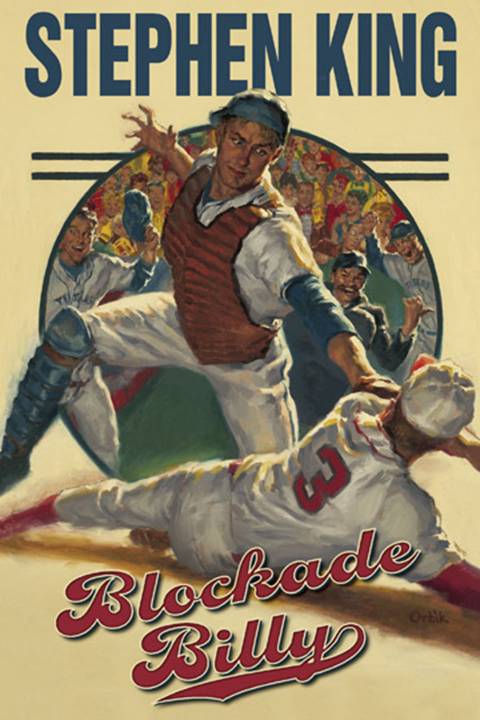 I stumbled upon what I'm hoping is a little gem at the West Wyandotte Public Library this week. It's a fairly new novella from Stephen King called "Blockade Billy." According to the novel's Wikipedia page, King wrote the baseball story in only two weeks.
Pretty impressive, even for a short, short novella.
The last Stephen King novel I reviewed on this blog was the pretty good "The Girl Who Loved Tom Gordon." Although not a baseball novel in subject, baseball plays a part of the backstory.
In "Blockade Billy," King puts baseball center stage.
Right now I'm finishing up Dee Brown's brilliant and enraging "Bury My Heart at Wounded Knee." After that, I'll read and review "Blockade Billy." The reading part should only take me a couple days.
One last note: I know he's Stephen King and everything, but I was a little astonished by the cover price of the tiny hardcover edition of the book. Twenty-five bucks.
I can't imaging paying $25 for a book that's about the length of a magazine article.
But people will pay any price for a book with that man's name on it.
--Matt Kelsey
Saturday, February 6, 2010
Henry Wiggen: Action Hero?
All due respect to the title character of this blog, my favorite fictional character of all time is Travis McGee.
McGee is the hero of a series of 21 novels written by author John D. McDonald from the 1960s all the way through to the '80s. McDonald was appreciated for his literary fiction (terrific books like Condominium and The Executioners, the title of which was later changed to match its big-screen adaptation - Cape Fear), but he was most well-known for Travis McGee.
The McGee books - which all had colors in their titles, like Nightmare in Pink and A Deadly Shade of Gold and The Girl in the Plain Brown Wrapper - were usually published as pulp-fiction mysteries. But the writing was anything but pulp. McDonald, who died in 1986, was a masterful writer.
A little background - Travis McGee is a beach bum who lives on a 52-foot houseboat called the Busted Flush (he won it in a card game). The boat is tied up at Slip F-18, Bahia Mar, Fort Lauderdale, Florida. To make money he is, in his own words, a "salvage consultant." Basically, he finds lost items. If somebody takes something of value from you, McGee will get it back and keep half its value as his fee. Because getting half of your lost fortune back is a whole lot better than nothing. McGee takes his retirement in installments between jobs.
I first became interested in Travis McGee when my dad gave me a stack of recommended books. Some I liked and some I didn't, but among the pile was a book called "Cinnamon Skin." It's the next-to-last book in the series. I read it in record time and absolutely loved it. I raided his libraries for more McGee books and found others at used book stores until I had about 13 in all. A few years later for Christmas, my wife bought me the remaining books in the series to complete my collection.
A couple weeks ago I picked up my dusty copy of "The Deep Blue Good-By," the first book in the McGee series, because it's written in first person. My own novel-in-progress is also in first-person, and I wanted to see how McDonald used the technique to his advantage. Before long I was pulled into the story and decided to read it through.
On Page 74, something caught my attention. McGee is trying to work his way next to a rich businessman, whom he hopes will help lead him to a lost fortune. But the beach bum looks somewhat unusual in a business suit. This is what he says:
I checked myself in a full-length mirror. I smiled at Mr. Travis McGee. A very deep tan is a tricky thing. If the clothing is the least bit too sharp, you look like an out-of-season ballplayer selling twenty pay life."
Woah.
Fans of this blog know Henry "Author" Wiggen is a ballplayer who, in the off season, sells life insurance.
I chalked this up to an unusual coincidence and kept reading. Then I came across this passage on Page 85. McGee is on an airplane, and being flirted with by a large-boned stewardess "styled for abundant lactation." Then McDonald drops this bomb:
...I had the curious feeling I had met her somewhere before, and then I remembered where - in that valuable book by Mark Harris, Bang the Drum Slowly, the stewardess that Author runs into when he is on his way out to Mayo's.
Holy crap.
Travis McGee was a Henry Wiggen fan!
Astounded over this discovery, I realized McGee and Wiggen aren't so different. McGee was a professional athlete, too, a tight end for the Detroit Lions. Wiggen and McGee both have an interesting perspective on life, one that becomes jaded as their perspective novel series continue. Both are ladykillers, although Henry settles down with Holly while McGee remains a confirmed bachelor. Both have well tuned bodies, Author a brilliant pitcher, McGee with reflexes so quick he has never once needed a flyswatter. In "A Ticket for a Seamstitch," Henry shows kindness toward a tender fallen bird of a woman; McGee makes a practice of this throughout the series.
In another life, could Henry Wiggen have been an action hero instead of a baseball star?
I like to think McGee and Wiggen were cut from the same cloth.
--Matt Kelsey
McGee is the hero of a series of 21 novels written by author John D. McDonald from the 1960s all the way through to the '80s. McDonald was appreciated for his literary fiction (terrific books like Condominium and The Executioners, the title of which was later changed to match its big-screen adaptation - Cape Fear), but he was most well-known for Travis McGee.
The McGee books - which all had colors in their titles, like Nightmare in Pink and A Deadly Shade of Gold and The Girl in the Plain Brown Wrapper - were usually published as pulp-fiction mysteries. But the writing was anything but pulp. McDonald, who died in 1986, was a masterful writer.
A little background - Travis McGee is a beach bum who lives on a 52-foot houseboat called the Busted Flush (he won it in a card game). The boat is tied up at Slip F-18, Bahia Mar, Fort Lauderdale, Florida. To make money he is, in his own words, a "salvage consultant." Basically, he finds lost items. If somebody takes something of value from you, McGee will get it back and keep half its value as his fee. Because getting half of your lost fortune back is a whole lot better than nothing. McGee takes his retirement in installments between jobs.
I first became interested in Travis McGee when my dad gave me a stack of recommended books. Some I liked and some I didn't, but among the pile was a book called "Cinnamon Skin." It's the next-to-last book in the series. I read it in record time and absolutely loved it. I raided his libraries for more McGee books and found others at used book stores until I had about 13 in all. A few years later for Christmas, my wife bought me the remaining books in the series to complete my collection.
A couple weeks ago I picked up my dusty copy of "The Deep Blue Good-By," the first book in the McGee series, because it's written in first person. My own novel-in-progress is also in first-person, and I wanted to see how McDonald used the technique to his advantage. Before long I was pulled into the story and decided to read it through.
On Page 74, something caught my attention. McGee is trying to work his way next to a rich businessman, whom he hopes will help lead him to a lost fortune. But the beach bum looks somewhat unusual in a business suit. This is what he says:
I checked myself in a full-length mirror. I smiled at Mr. Travis McGee. A very deep tan is a tricky thing. If the clothing is the least bit too sharp, you look like an out-of-season ballplayer selling twenty pay life."
Woah.
Fans of this blog know Henry "Author" Wiggen is a ballplayer who, in the off season, sells life insurance.
I chalked this up to an unusual coincidence and kept reading. Then I came across this passage on Page 85. McGee is on an airplane, and being flirted with by a large-boned stewardess "styled for abundant lactation." Then McDonald drops this bomb:
...I had the curious feeling I had met her somewhere before, and then I remembered where - in that valuable book by Mark Harris, Bang the Drum Slowly, the stewardess that Author runs into when he is on his way out to Mayo's.
Holy crap.
Travis McGee was a Henry Wiggen fan!
Astounded over this discovery, I realized McGee and Wiggen aren't so different. McGee was a professional athlete, too, a tight end for the Detroit Lions. Wiggen and McGee both have an interesting perspective on life, one that becomes jaded as their perspective novel series continue. Both are ladykillers, although Henry settles down with Holly while McGee remains a confirmed bachelor. Both have well tuned bodies, Author a brilliant pitcher, McGee with reflexes so quick he has never once needed a flyswatter. In "A Ticket for a Seamstitch," Henry shows kindness toward a tender fallen bird of a woman; McGee makes a practice of this throughout the series.
In another life, could Henry Wiggen have been an action hero instead of a baseball star?
I like to think McGee and Wiggen were cut from the same cloth.
--Matt Kelsey
Saturday, January 30, 2010
Not-so-baseball novel review: "The Girl Who Loved Tom Gordon"
Stephen King's short novel "The Girl Who Loved Tom Gordon" is not really about baseball, but in reality, no good baseball book is really about baseball.
And King's book is not about Tom Gordon, the former Royals star and then a popular journeyman reliever.
"The Girl Who Loved Tom Gordon" is about a little girl who gets lost in the woods. But it's not really about that, either.
Think about that concept, though, for a moment. A little girl. Lost. In the woods. Just the thought of it is terrifying, maybe more frightening than any horrific monster Stephen King has ever imagined.
At its heart, "The Girl Who Loved Tom Gordon" is about fear.
I'll be honest: I'm not a huge Stephen King fan. I've read "Misery," and I've read a handful of short stories whenever they appear in Esquire or on a Web site I frequent. And I've seen "The Green Mile" and "The Shawshank Redemption," two works of Stephen King's imagination. But I'm not a diehard follower, like so many people are. I picked up "The Girl Who Loved Tom Gordon" from the discount rack at Half Price Books because I'm into baseball novels. And I knew this wasn't really a baseball novel. But still, I wanted to give it a try.
And I'm glad I did.
"The Girl" has all the qualities that makes Stephen King's work so great and, I imagine, so tantalizing for his loyal fans. It has an edge of creepiness during certain scenes. Just the tiniest whiff of something not quite right.
In the book, the main character, Trisha, a tried-and-true Red Sox fan with a major crush on then Red Sox closer Tom Gordon, is on a hiking trip with her argumentative mother and brother. While the two of them are fighting, Trisha sneaks off the trail for a second to take a pee. When she's done, she tries to take a shortcut back to her family. But she can't find the trail.
And she begins to wander around in the woods. For days and days.
Her companions on the trip include a Walkman radio, with which she listens to Red Sox games every night on the AM band, and an imaginary image of Tom Gordon, who follows along with her, talks to her and teaches her the art of closing.
While most of the tale centers around Trisha's journey through the woods, occasionally the story flashes over to the search for the little girl. King does this brilliantly, switching between scenes within paragraphs, and even within sentences, without an unwieldy break in the narrative.
Here's my only criticism. I think King got a little too caught up in working in supernatural stuff and sometimes ignores the truly frightening story - the little girl lost in the woods. Sometimes, he can't see the forest for the trees - pardon the pun.
But it's a nice read, and a quick one, too.
It's not about baseball, but it is about baseball fandom to some extent.
And, of course, fear.
--Matt Kelsey
And King's book is not about Tom Gordon, the former Royals star and then a popular journeyman reliever.
"The Girl Who Loved Tom Gordon" is about a little girl who gets lost in the woods. But it's not really about that, either.
Think about that concept, though, for a moment. A little girl. Lost. In the woods. Just the thought of it is terrifying, maybe more frightening than any horrific monster Stephen King has ever imagined.
At its heart, "The Girl Who Loved Tom Gordon" is about fear.
I'll be honest: I'm not a huge Stephen King fan. I've read "Misery," and I've read a handful of short stories whenever they appear in Esquire or on a Web site I frequent. And I've seen "The Green Mile" and "The Shawshank Redemption," two works of Stephen King's imagination. But I'm not a diehard follower, like so many people are. I picked up "The Girl Who Loved Tom Gordon" from the discount rack at Half Price Books because I'm into baseball novels. And I knew this wasn't really a baseball novel. But still, I wanted to give it a try.
And I'm glad I did.
"The Girl" has all the qualities that makes Stephen King's work so great and, I imagine, so tantalizing for his loyal fans. It has an edge of creepiness during certain scenes. Just the tiniest whiff of something not quite right.
In the book, the main character, Trisha, a tried-and-true Red Sox fan with a major crush on then Red Sox closer Tom Gordon, is on a hiking trip with her argumentative mother and brother. While the two of them are fighting, Trisha sneaks off the trail for a second to take a pee. When she's done, she tries to take a shortcut back to her family. But she can't find the trail.
And she begins to wander around in the woods. For days and days.
Her companions on the trip include a Walkman radio, with which she listens to Red Sox games every night on the AM band, and an imaginary image of Tom Gordon, who follows along with her, talks to her and teaches her the art of closing.
While most of the tale centers around Trisha's journey through the woods, occasionally the story flashes over to the search for the little girl. King does this brilliantly, switching between scenes within paragraphs, and even within sentences, without an unwieldy break in the narrative.
Here's my only criticism. I think King got a little too caught up in working in supernatural stuff and sometimes ignores the truly frightening story - the little girl lost in the woods. Sometimes, he can't see the forest for the trees - pardon the pun.
But it's a nice read, and a quick one, too.
It's not about baseball, but it is about baseball fandom to some extent.
And, of course, fear.
--Matt Kelsey
Saturday, January 9, 2010
"The Bad News Bears" is the best baseball movie ever
 -www.filmcatcher.com
And here are 10 reasons why:
10. The classical music soundtrack, from the opera "Carmen." It's the perfect baseball score.
9. The introduction of the phrase "Kelly Leak" as a verb. Definition: when a batter hits a pitch during an intentional walk attempt; ie: "Albert Pujols just Kelly Leaked the ball over the fence."
8. Walter Matthau, Tatum O'Neal and Jackie Earle Haley.
7. The movie's ability to make viewers want to root for characters who are completely, fundamentally unlikeable. Matthau's character, Buttermaker, is a prime example. During the course of the movie he drives drunk with un-seatbelted children in the car, he throws a beer in the face of a teenaged girl, he instructs one of his players to take a pitch for the team and he verbally abuses children nearly the entire film. But you end up loving the guy. The most surprising example, though, is the character Joey Turner, the starting pitcher for the bad-guy Yankees and the son of the Yankees' dastardly manager. Joey acts like an ass toward the Bears the entire movie, but near the end he rebels against his dad in a magnificent way. In an amazing and heart-wrenching scene, little Joey becomes one of the movie's best heroes.
6. Joey's mom.
5. Miguel Aguilar, the cutest ballplayer since Eddie Gaedel.
4. Chico's Bail Bonds.
3. Tanner Boyle, the diminutive shortstop with the courage of all the lions in all the jungles in all the world.

2. Tiny second-place trophies; finding victory in defeat (and in making fun of the winner); and beer-soaked victory celebrations.
1. "And another thing - just wait 'til next year!"
--Matt Kelsey
Monday, January 4, 2010
Here's a great Web site for writers
If anybody's interested, my query letter for my recently-completed but yet-to-be-published novel, "The Rough on the Diamond," has been uploaded onto The Public Query Slushpile.
The Slushpile is a great Web site for aspiring novelists. It's a place where query letters (basically, the pitch letter novelists use to entice literary agents) are posted, and other novelists and interested readers can make comments and criticisms.
I've already received several very insightful and helpful comments, but I could always use more - so log on and comment away!
--Matt Kelsey
The Slushpile is a great Web site for aspiring novelists. It's a place where query letters (basically, the pitch letter novelists use to entice literary agents) are posted, and other novelists and interested readers can make comments and criticisms.
I've already received several very insightful and helpful comments, but I could always use more - so log on and comment away!
--Matt Kelsey
Friday, December 11, 2009
Book review: "The Veracruz Blues"
I feel like a fool.
That's not an uncommon condition for me, but particularly today. I finished reading "The Veracruz Blues" several weeks ago and put it on the shelf, thinking about what I'd write in my review. It's the second time I've read it and this time around I didn't necessarily love the book, but I didn't have anything bad to say about it either.
Finally, today I told myself to buckle down and write the review, even if it's terrible, just to get it out of the way. And I did. I wrote nearly a full review on "The Veracruz Blues," calling it a slightly-above average telling of a far-fetched fictional baseball league, much in the same vein as Philip Roth's "The Great American Novel." But then I stumbled upon a page at the front of the book that says "Although the events in this novel are based on things that really happened, this book is a work of the imagination."
Surely not, I thought to myself. Surely this ridiculous story of a Mexican baseball league couldn't be real.
Of course, I was wrong. The Mexican League was (and is) very real, and the characters in Mark Winegardner's novel are also quite real. I feel foolish for not knowing about this fascinating chunk of baseball history.
With one keystroke I deleted my previous review. This novel is so much more intriguing now that I know the story is not as far-fetched as I first thought.
"The Veracruz Blues" tells the story through the eyes of (fictional) aspiring novelist-turned-reluctant sportswriter Frank Bullinger, Jr., who is called away from his job covering the sad-sack St. Louis Browns to be the press agent for the Mexican League, operated by Jorge Pasquel (real). The story of the tumultuous 1946 season is told through a series of interviews with some figures important to the Mexican League, including Bullinger, players Danny Gardella (real), Roberto Ortiz (real) and Theolic "Fireball" Smith (fictional, I think), as well as Maria Felix (real), a famous Mexican actress portrayed as Jorge Pasquel's girlfriend (I think that's fictional).
During that '46 season, Pasquel and his brothers (real) try to entice several big-name American major leaguers to come play in the Mexican League for a lot more money (real). They offer big contracts to the likes of Ted Williams and Stan Musial (real) to no avail, but more than a few prominent ballplayers do "jump" to the Mexican League, including Sal Maglie, Mickey Owen and Max Lanier (all real, and all really jumped to Mexico).
Danny Gardella, one of the major characters in the book, seems to have a fascinating real-life history of being a bit of a clown prince on the field and one of the founding fathers of the free agency system in baseball, setting the stage for Curt Flood and others to give ballplayers the right to play for whomever they wanted.
And as I mentioned before, this is one of the few baseball books that is told, at least in part, from the perspective of a woman, Maria Felix.
So I'm gonna think about this book a little more. I may or may not write more about it. But now that I realize it's almost all true... wow. Fascinating.
--Matt Kelsey
That's not an uncommon condition for me, but particularly today. I finished reading "The Veracruz Blues" several weeks ago and put it on the shelf, thinking about what I'd write in my review. It's the second time I've read it and this time around I didn't necessarily love the book, but I didn't have anything bad to say about it either.
Finally, today I told myself to buckle down and write the review, even if it's terrible, just to get it out of the way. And I did. I wrote nearly a full review on "The Veracruz Blues," calling it a slightly-above average telling of a far-fetched fictional baseball league, much in the same vein as Philip Roth's "The Great American Novel." But then I stumbled upon a page at the front of the book that says "Although the events in this novel are based on things that really happened, this book is a work of the imagination."
Surely not, I thought to myself. Surely this ridiculous story of a Mexican baseball league couldn't be real.
Of course, I was wrong. The Mexican League was (and is) very real, and the characters in Mark Winegardner's novel are also quite real. I feel foolish for not knowing about this fascinating chunk of baseball history.
With one keystroke I deleted my previous review. This novel is so much more intriguing now that I know the story is not as far-fetched as I first thought.
"The Veracruz Blues" tells the story through the eyes of (fictional) aspiring novelist-turned-reluctant sportswriter Frank Bullinger, Jr., who is called away from his job covering the sad-sack St. Louis Browns to be the press agent for the Mexican League, operated by Jorge Pasquel (real). The story of the tumultuous 1946 season is told through a series of interviews with some figures important to the Mexican League, including Bullinger, players Danny Gardella (real), Roberto Ortiz (real) and Theolic "Fireball" Smith (fictional, I think), as well as Maria Felix (real), a famous Mexican actress portrayed as Jorge Pasquel's girlfriend (I think that's fictional).
During that '46 season, Pasquel and his brothers (real) try to entice several big-name American major leaguers to come play in the Mexican League for a lot more money (real). They offer big contracts to the likes of Ted Williams and Stan Musial (real) to no avail, but more than a few prominent ballplayers do "jump" to the Mexican League, including Sal Maglie, Mickey Owen and Max Lanier (all real, and all really jumped to Mexico).
Danny Gardella, one of the major characters in the book, seems to have a fascinating real-life history of being a bit of a clown prince on the field and one of the founding fathers of the free agency system in baseball, setting the stage for Curt Flood and others to give ballplayers the right to play for whomever they wanted.
And as I mentioned before, this is one of the few baseball books that is told, at least in part, from the perspective of a woman, Maria Felix.
So I'm gonna think about this book a little more. I may or may not write more about it. But now that I realize it's almost all true... wow. Fascinating.
--Matt Kelsey
Tuesday, November 24, 2009
Novel notes: "The Veracruz Blues." Plus, a great book on a terrible war
A couple months ago, I mentioned on this blog that I'd exhuasted my personal baseball fiction library. Not long ago I discovered I was wrong. I was overlooking a baseball novel, and a good one at that: Mark Winegardner's "The Veracruz Blues."
In John Lofflin's baseball fiction class, this book was an "optional" read, but in the pantheon of baseball fiction "The Veracruz Blues" holds a special place in that part of the book is narrated by a woman - the only baseball book, to my knowledge, with this distinction.
More about "The Veracruz Blues" later. But now, truly, I HAVE exhausted my baseball library, and once again I'm open to suggestions on what to read next in the series.
In the meantime, I'll mention another great book I recently read: Jon Krakauer's "Where Men Win Glory: The Odyssey of Pat Tillman." As you may know, Pat Tillman was a football player for the Arizona Cardinals when, after the Sept. 11, 2001 attacks, he became an Army ranger. A few years later he was killed in Afghanistan, and his enlistment and heroic death were held up by conservative pundits as a model of patriotic glory.
The truth, though, is far, far different. Pat Tillman vehemently refused to let the Army and the Bush Administration put him on a pedestal (even though they did anyway, both before and after his death). What's worse, Tillman was actually killed by friendly fire, a fact the Army tried to cover up so as not to sully the fabricated story of their most well-known fallen hero.
It's one of those books that makes you sad and pissed off and furious all at once. The book is not only the story of Pat Tillman's amazing life but also a scathing critique of the Bush administration. As such, I consider it a must-read.
--Matt Kelsey
In John Lofflin's baseball fiction class, this book was an "optional" read, but in the pantheon of baseball fiction "The Veracruz Blues" holds a special place in that part of the book is narrated by a woman - the only baseball book, to my knowledge, with this distinction.
More about "The Veracruz Blues" later. But now, truly, I HAVE exhausted my baseball library, and once again I'm open to suggestions on what to read next in the series.
In the meantime, I'll mention another great book I recently read: Jon Krakauer's "Where Men Win Glory: The Odyssey of Pat Tillman." As you may know, Pat Tillman was a football player for the Arizona Cardinals when, after the Sept. 11, 2001 attacks, he became an Army ranger. A few years later he was killed in Afghanistan, and his enlistment and heroic death were held up by conservative pundits as a model of patriotic glory.
The truth, though, is far, far different. Pat Tillman vehemently refused to let the Army and the Bush Administration put him on a pedestal (even though they did anyway, both before and after his death). What's worse, Tillman was actually killed by friendly fire, a fact the Army tried to cover up so as not to sully the fabricated story of their most well-known fallen hero.
It's one of those books that makes you sad and pissed off and furious all at once. The book is not only the story of Pat Tillman's amazing life but also a scathing critique of the Bush administration. As such, I consider it a must-read.
--Matt Kelsey
Friday, October 30, 2009
The old men in the World Series: Autumn has arrived: Former Royals drive Phils
What we saw last night in Yankee Stadium is a perfect example of the beauty of baseball.
Because baseball is organic, because it has seasons, because players have lifespans within the game, baseball is a perfect subject for novel writers. Players emerge in the game as boys, mature, become men, and leave the game as old men, sometimes staying too long, rarely leaving too soon.
In baseball we see the new tender leaves sprout and we see the leaves fall.
And so last night we witnessed the very nature of aging, of growing old. And at times it made us cheer. It also reminded us youth does not last forever, and our strength and wiles have their limits.
For five innings, Pedro Martinez defied age. Even without a major-league fastball, the old man struck out eight Yankees using precision and wisdom. His performance was something old men could cheer.
And then his house of cards came crashing down. We knew it would; everybody in Yankee stadium knew it would. But it was reassuring to watch as long as it lasted and it was the sort of drama only baseball can bring.
Then the masterful Rivera came on and, uncharacteristically, got in trouble and we were reminded again "after all he is 39 years old." He managed to escape but it is clear even number 42 can't defeat age.
I think we see two kinds of age. Physical Age is a force of nature. We can try, medical science can try, but Physical Age will win. Mental Age is something else. Mentally, we can push back against nature. Perhaps our spirit is even ageless.
I remember walking away from our last 60-and-over ball game this fall on a disappointing damp wet night. The boys (perpetually of autumn) were saying their goodbyes, see you next springs. And they were talking to each other about what they would do this winter to get ready, to be better. They talked of lifting weights and jogging and -- above all else -- of being twenty pounds thinner when the sun comes back and the leaves are tender. Sixty-some years old and we're still thinking about getting better.
We, no doubt, watched those two aging pitchers last night with special joy.
And, some of us made arrangements for batting practice this weekend.
PPS: Tom points out how much fun it is to watch Charlie Manual manage a team old-school style, and I agree. He may have made the classic mistake of riding the horse one inning too long, but still I like to see a manager who smiles once in a while and lets the boys play a bit. Younger managers seem much more like control freaks. Of course, my favorite manager is in John R. Tunis' World Series -- a player-manager battling his own age issues.
I almost forgot to mention Matty Stairs, as well. Can't catch up to the fastball, Joe Morgan said (over and over). Hmmmm... Think he had the only Philly RBI, didn't he?
And how much would you give to go back in time and reverse the stupidity of letting Raul Ibanez leave? Come to think of it, former Royals accounted for the only run Philly scored last night. Makes you proud, eh?
--Lofflin
Because baseball is organic, because it has seasons, because players have lifespans within the game, baseball is a perfect subject for novel writers. Players emerge in the game as boys, mature, become men, and leave the game as old men, sometimes staying too long, rarely leaving too soon.
In baseball we see the new tender leaves sprout and we see the leaves fall.
And so last night we witnessed the very nature of aging, of growing old. And at times it made us cheer. It also reminded us youth does not last forever, and our strength and wiles have their limits.
For five innings, Pedro Martinez defied age. Even without a major-league fastball, the old man struck out eight Yankees using precision and wisdom. His performance was something old men could cheer.
And then his house of cards came crashing down. We knew it would; everybody in Yankee stadium knew it would. But it was reassuring to watch as long as it lasted and it was the sort of drama only baseball can bring.
Then the masterful Rivera came on and, uncharacteristically, got in trouble and we were reminded again "after all he is 39 years old." He managed to escape but it is clear even number 42 can't defeat age.
I think we see two kinds of age. Physical Age is a force of nature. We can try, medical science can try, but Physical Age will win. Mental Age is something else. Mentally, we can push back against nature. Perhaps our spirit is even ageless.
I remember walking away from our last 60-and-over ball game this fall on a disappointing damp wet night. The boys (perpetually of autumn) were saying their goodbyes, see you next springs. And they were talking to each other about what they would do this winter to get ready, to be better. They talked of lifting weights and jogging and -- above all else -- of being twenty pounds thinner when the sun comes back and the leaves are tender. Sixty-some years old and we're still thinking about getting better.
We, no doubt, watched those two aging pitchers last night with special joy.
And, some of us made arrangements for batting practice this weekend.
PPS: Tom points out how much fun it is to watch Charlie Manual manage a team old-school style, and I agree. He may have made the classic mistake of riding the horse one inning too long, but still I like to see a manager who smiles once in a while and lets the boys play a bit. Younger managers seem much more like control freaks. Of course, my favorite manager is in John R. Tunis' World Series -- a player-manager battling his own age issues.
I almost forgot to mention Matty Stairs, as well. Can't catch up to the fastball, Joe Morgan said (over and over). Hmmmm... Think he had the only Philly RBI, didn't he?
And how much would you give to go back in time and reverse the stupidity of letting Raul Ibanez leave? Come to think of it, former Royals accounted for the only run Philly scored last night. Makes you proud, eh?
--Lofflin
Monday, October 26, 2009
Book review: "The Great American Novel"
I took enough time off from playoff baseball and the Balloon Boy saga to finish Philip Roth's wonderfully complex book, "The Great American Novel." It's perhaps one of the most peculiar, hilarious and fascinating baseball novels out there.
"The Great American Novel" is told from the perspective of a disgraced journalist named Word Smith ("Fella name a' Smith, first name a' Word"). 'Smitty,' who claims to be an advisor to presidents, a man who plays cards with Popes and a friend of Ernest Hemingway (later on in the review series we'll talk more about Hemingway's presence in baseball novels), decides he's going to write the 'great American novel' about the history of the Patriot League, a baseball league he says existed until just shortly after World War II. After a lengthy prologue (46 pages!) about Smitty's dubious attempt to get a Patriot League star into the Baseball Hall of Fame, "The Great American Novel" is exactly that: a history of the Patriot League.
Most particularly, the book focuses on an East Coast team called the Ruppert Mundys, which hails from the town of Port Ruppert and has a storied history and a passionate fan base called the Rupe-it Rootas. But when World War II breaks out, the team's owners, the Mundy brothers, allow the War Department to use the home stadium as a military base, making the Mundys a permanent road team for the 1943 season.
We're introduced to all the Mundy players, including a one-armed outfielder, a one-legged catcher, ancient pitchers, a fourteen-year-old second baseman and a center fielder who may just be the best ballplayer on the whole damn planet. And we also meet other characters around the league, including three particularly fascinating team owners. Frank Mazuma is a tireless promoter (think Charlie Finley on steroids) who hires midgets and - gasp! - African Americans to play on his team. Ellis Goldberg, a tight-fisted, stereotypical Jew who is hated by all his players, has a prepubescent son named Isaac, an early-day sabermatrician who would make Bill James proud. And then there's Angela Whittling Trust, who inherited her team from her late husband. She rattles on about the "enemies of America" and believes the President of the United States to be one of them (sound familiar?). Although she rails against Communists during WWII, her dialogue could almost have been lifted directly from Fox News circa 2009:
...We are dealing with an enemy far more cunning and insidious than that deluded psychopath [Hitler] out to conquer the world with bombs and bullets. No, even while this war rages on against the Germans and the Japs, the other war against us has already begun, the invisible war, the silent assault upon the very fabric that holds us together as a nation.
As you can see, Roth's book, written in 1973, is decades before its time. But I wouldn't be surprised if he was influenced by other baseball writers. The story of Patriot League pitcher Gil Gamesh sounds an awful lot like Jock Casey from Robert Coover's "The Universal Baseball Association, Inc., J. Henry Waugh, Prop," written a few years earlier. And the informal style of Smitty is reminiscent of Henry Wiggen from Mark Harris' delightful series, which began in the 1950s.
Roth is influential, too, not only in his baseball books but in his whole library of groundbreaking fiction.
"The Great American Novel," although it fails to live up to its lofty title, is a fine baseball book from one of the authors of our time.
And, it's one of the funniest books I've ever read.
--Matt Kelsey
"The Great American Novel" is told from the perspective of a disgraced journalist named Word Smith ("Fella name a' Smith, first name a' Word"). 'Smitty,' who claims to be an advisor to presidents, a man who plays cards with Popes and a friend of Ernest Hemingway (later on in the review series we'll talk more about Hemingway's presence in baseball novels), decides he's going to write the 'great American novel' about the history of the Patriot League, a baseball league he says existed until just shortly after World War II. After a lengthy prologue (46 pages!) about Smitty's dubious attempt to get a Patriot League star into the Baseball Hall of Fame, "The Great American Novel" is exactly that: a history of the Patriot League.
Most particularly, the book focuses on an East Coast team called the Ruppert Mundys, which hails from the town of Port Ruppert and has a storied history and a passionate fan base called the Rupe-it Rootas. But when World War II breaks out, the team's owners, the Mundy brothers, allow the War Department to use the home stadium as a military base, making the Mundys a permanent road team for the 1943 season.
We're introduced to all the Mundy players, including a one-armed outfielder, a one-legged catcher, ancient pitchers, a fourteen-year-old second baseman and a center fielder who may just be the best ballplayer on the whole damn planet. And we also meet other characters around the league, including three particularly fascinating team owners. Frank Mazuma is a tireless promoter (think Charlie Finley on steroids) who hires midgets and - gasp! - African Americans to play on his team. Ellis Goldberg, a tight-fisted, stereotypical Jew who is hated by all his players, has a prepubescent son named Isaac, an early-day sabermatrician who would make Bill James proud. And then there's Angela Whittling Trust, who inherited her team from her late husband. She rattles on about the "enemies of America" and believes the President of the United States to be one of them (sound familiar?). Although she rails against Communists during WWII, her dialogue could almost have been lifted directly from Fox News circa 2009:
...We are dealing with an enemy far more cunning and insidious than that deluded psychopath [Hitler] out to conquer the world with bombs and bullets. No, even while this war rages on against the Germans and the Japs, the other war against us has already begun, the invisible war, the silent assault upon the very fabric that holds us together as a nation.
As you can see, Roth's book, written in 1973, is decades before its time. But I wouldn't be surprised if he was influenced by other baseball writers. The story of Patriot League pitcher Gil Gamesh sounds an awful lot like Jock Casey from Robert Coover's "The Universal Baseball Association, Inc., J. Henry Waugh, Prop," written a few years earlier. And the informal style of Smitty is reminiscent of Henry Wiggen from Mark Harris' delightful series, which began in the 1950s.
Roth is influential, too, not only in his baseball books but in his whole library of groundbreaking fiction.
"The Great American Novel," although it fails to live up to its lofty title, is a fine baseball book from one of the authors of our time.
And, it's one of the funniest books I've ever read.
--Matt Kelsey
Friday, October 9, 2009
Novel notes: "The Great American Novel"
I was lucky enough to find a tattered copy of Philip Roth's "The Great American Novel" at my local library. And it's a damn good read, perhaps one of the funniest books I've ever read, baseball-related or otherwise. (And correct me if I'm wrong, but I don't believe Roth is noted for being a funny writer.)
I'm still reading it, but I wanted to share a really great line that I believe sums up Roth's writing style. The line is referring to an aged but still beautiful woman named Angela Trust who is the owner of a baseball team in the now-defunct Patriot League. She inherited the team from her husband, for whom she has a great amount of respect and reverence now that he's dead. She has also had heated affairs with some of baseball's biggest names, including Ty Cobb and Babe Ruth.
This is how Roth describes Angela Trust's love life:
There had been five men in her life who mattered, and none had been her husband; her affair with him had begun only after he was in the ground.
It's shockingly good writing.
Most of Roth's best lines in the book are aimed at humor, and I've found myself laughing out loud several times.
The book is due back at the library in a week, so I'll either have a review done soon or I'll have to recheck it.
--Matt Kelsey
I'm still reading it, but I wanted to share a really great line that I believe sums up Roth's writing style. The line is referring to an aged but still beautiful woman named Angela Trust who is the owner of a baseball team in the now-defunct Patriot League. She inherited the team from her husband, for whom she has a great amount of respect and reverence now that he's dead. She has also had heated affairs with some of baseball's biggest names, including Ty Cobb and Babe Ruth.
This is how Roth describes Angela Trust's love life:
There had been five men in her life who mattered, and none had been her husband; her affair with him had begun only after he was in the ground.
It's shockingly good writing.
Most of Roth's best lines in the book are aimed at humor, and I've found myself laughing out loud several times.
The book is due back at the library in a week, so I'll either have a review done soon or I'll have to recheck it.
--Matt Kelsey
Wednesday, September 16, 2009
Book review: "Box Socials"
While John has been working hard to chronicle our growing readership this week, I've been busy turning 30. That's right, I hit the big milestone yesterday. One of my late-twenty-something friends politely pointed out that she'd "never be as old" as me. And my wife has been quick to note that she's only 28 (even though in a month she'll be 29).
Although my old-man eyesight is quickly fading and I have to be in bed by 9 p.m., I've also had time to do some reading lately. My most recent baseball novel conquest "Box Socials" by W.P. Kinsella.
Kinsella found success and fortune with his classic baseball novel, "Shoeless Joe," and he worked hard to make lightning strike again with his later novels, many of which also focused on the game. "Box Socials" starts with a little bit of baseball and ends with a little bit of baseball, but the middle is filled with a whole lot of something else.
Now, most baseball novels I've read aren't really about baseball at all. But most of "Box Socials" takes place so far away from the game, I'd be hesitant to call it a baseball novel if it was written by anyone else.
Before I read "Box Socials," I had a couple opinions of the novel to choose from. John says he didn't like it at all, but my wife - whom we've proven is much smarter than me - absolutely loves this book. Not surprisingly, I fall somewhere in the middle.
The first section of "Box Socials" works really well. We're introduced to a unique, rural area outside of Edmonton, Alberta, referred to as the Six Towns and the interesting and oddly-named people who live there through the eyes of a wonderful unreliable narrator. But in the second section, the previously-unnamed narrator is suddenly given a name. I'm not sure why; I think Kinsella could have easily found a way to write the book without revealing the narrator's identity.
Anyway. "Box Socials" tells the story - in a roundabout way - of Truckbox Al McClintock, a ballplayer in the Six Towns area who once hit five home runs in one game, four of them into and one clean across the Pembina River. Because of his display, Truckbox Al was given a chance to play in an exhibition game "against a team of genuine Major Leaguers, which included Bob Feller, Hal Newhouser, and Joe DiMaggio himself."
That's all set up in the first couple pages. The exhibition game takes place on the last couple pages of the book. Baseball is only mentioned in passing the rest of the way through.
But the stuff in the middle is not necessarily bad. It's just different. The writing style is at times delightful, but its use of repetitive phrases can be downright infuriating. I'd venture to say "Box Socials" is more well-written than "Shoeless Joe," which had its flaws in style, but of course Kinsella's most famous work had a much more classic and timeless story.
"Box Socials" is not your typical baseball book. In fact, it's not really a baseball book at all. But that doesn't mean you shouldn't read it.
I think if Kinsella had found a way to conceal the identity of his narrator, "Box Socials" might be his best work. But what we have instead is a novel that is complex and over-simple, beautiful and ugly all at the same time.
--Matt Kelsey
Although my old-man eyesight is quickly fading and I have to be in bed by 9 p.m., I've also had time to do some reading lately. My most recent baseball novel conquest "Box Socials" by W.P. Kinsella.
Kinsella found success and fortune with his classic baseball novel, "Shoeless Joe," and he worked hard to make lightning strike again with his later novels, many of which also focused on the game. "Box Socials" starts with a little bit of baseball and ends with a little bit of baseball, but the middle is filled with a whole lot of something else.
Now, most baseball novels I've read aren't really about baseball at all. But most of "Box Socials" takes place so far away from the game, I'd be hesitant to call it a baseball novel if it was written by anyone else.
Before I read "Box Socials," I had a couple opinions of the novel to choose from. John says he didn't like it at all, but my wife - whom we've proven is much smarter than me - absolutely loves this book. Not surprisingly, I fall somewhere in the middle.
The first section of "Box Socials" works really well. We're introduced to a unique, rural area outside of Edmonton, Alberta, referred to as the Six Towns and the interesting and oddly-named people who live there through the eyes of a wonderful unreliable narrator. But in the second section, the previously-unnamed narrator is suddenly given a name. I'm not sure why; I think Kinsella could have easily found a way to write the book without revealing the narrator's identity.
Anyway. "Box Socials" tells the story - in a roundabout way - of Truckbox Al McClintock, a ballplayer in the Six Towns area who once hit five home runs in one game, four of them into and one clean across the Pembina River. Because of his display, Truckbox Al was given a chance to play in an exhibition game "against a team of genuine Major Leaguers, which included Bob Feller, Hal Newhouser, and Joe DiMaggio himself."
That's all set up in the first couple pages. The exhibition game takes place on the last couple pages of the book. Baseball is only mentioned in passing the rest of the way through.
But the stuff in the middle is not necessarily bad. It's just different. The writing style is at times delightful, but its use of repetitive phrases can be downright infuriating. I'd venture to say "Box Socials" is more well-written than "Shoeless Joe," which had its flaws in style, but of course Kinsella's most famous work had a much more classic and timeless story.
"Box Socials" is not your typical baseball book. In fact, it's not really a baseball book at all. But that doesn't mean you shouldn't read it.
I think if Kinsella had found a way to conceal the identity of his narrator, "Box Socials" might be his best work. But what we have instead is a novel that is complex and over-simple, beautiful and ugly all at the same time.
--Matt Kelsey
Wednesday, August 26, 2009
End of the line?
I've pretty much exhausted my baseball fiction library, and I'm looking for direction on what I should do next with my baseball novel review series.
I'm down to the last book on my shelf: "Box Socials," by W.P. Kinsella. I thought I had a copy of Ring Lardner's "You Know Me Al," but I can't find it.
So what should I do after I finish "Box Socials?" I guess there would be some harmony in ending the series with that book, since I started it (way back in February) with Kinsella's "Shoeless Joe."
At least one reader wouldn't mind seeing me hang it up. "Anonymous" made this comment on my review of "It Looked Like For Ever" -
Bad review, of a bad book. Matt, you reached a new low with this mess of a blog.
To which I replied:
Sir or Ma'am, you insult me! How dare you say I've reached a new low! I've reached MUCH lower lows than this!
I could also start reviewing non-fiction, but I don't really want to at this point.
I think I'd rather keep it going, though, with other baseball novels not on my shelf. And I wouldn't mind expanding my personal library in the process.
So here's the deal. I'm open to suggestions on what baseball novels I should review next. If I can't find them at the good ol' KCK Public Library, I'll try to track them down at Half Price Books or Amazon. Leave me any thoughts you have in the comments section. And remember, for right now I'm only interested in reviewing baseball fiction, not player biographies or histories.
"Anonymous," I'll take your suggestions, too, although keep in mind I don't live near any bridges off of which I can throw myself.
-- Matt Kelsey
I'm down to the last book on my shelf: "Box Socials," by W.P. Kinsella. I thought I had a copy of Ring Lardner's "You Know Me Al," but I can't find it.
So what should I do after I finish "Box Socials?" I guess there would be some harmony in ending the series with that book, since I started it (way back in February) with Kinsella's "Shoeless Joe."
At least one reader wouldn't mind seeing me hang it up. "Anonymous" made this comment on my review of "It Looked Like For Ever" -
Bad review, of a bad book. Matt, you reached a new low with this mess of a blog.
To which I replied:
Sir or Ma'am, you insult me! How dare you say I've reached a new low! I've reached MUCH lower lows than this!
I could also start reviewing non-fiction, but I don't really want to at this point.
I think I'd rather keep it going, though, with other baseball novels not on my shelf. And I wouldn't mind expanding my personal library in the process.
So here's the deal. I'm open to suggestions on what baseball novels I should review next. If I can't find them at the good ol' KCK Public Library, I'll try to track them down at Half Price Books or Amazon. Leave me any thoughts you have in the comments section. And remember, for right now I'm only interested in reviewing baseball fiction, not player biographies or histories.
"Anonymous," I'll take your suggestions, too, although keep in mind I don't live near any bridges off of which I can throw myself.
-- Matt Kelsey
Friday, August 21, 2009
I almost forgot: one last great reason to read "The Universal Baseball Association"
Happy Friday, everyone.
I had planned on mentioning this earlier, because I think it's important about "The Universal Baseball Association, Inc., J. Henry Waugh, Prop." by Robert Coover. But looking back over my review of the book and my earlier notes, I realized I left it out.
Here it is, my one last great reason to read the book:
"The Universal Baseball Association" has two of the best, most erotic sex scenes I've ever read.
No joke.
-- Matt Kelsey
I had planned on mentioning this earlier, because I think it's important about "The Universal Baseball Association, Inc., J. Henry Waugh, Prop." by Robert Coover. But looking back over my review of the book and my earlier notes, I realized I left it out.
Here it is, my one last great reason to read the book:
"The Universal Baseball Association" has two of the best, most erotic sex scenes I've ever read.
No joke.
-- Matt Kelsey
Sunday, August 16, 2009
Book review: "The Universal Baseball Association, Inc., J. Henry Waugh, Prop."
Matt Kelsey has won five consecutive Cy Young Awards. He is, by all accounts, the finest pitcher to throw a baseball since the retirement of Roger Clemens and Greg Maddux and quite possibly one of the greatest baseball players of all time. A perennial All-Star, Kelsey is almost certain to make it into the Hall of Fame. At 31 years old, he is on the last year of a 4-year, $100 million contract with the San Francisco Giants, and he's hopeful for a $200 million payday on his next contract.
But Matt Kelsey the unemployed writer and wannabe novelist is growing bored with Matt Kelsey the pitcher, who exists only as ones and zeros in the confines of the SD chip inside my PlayStation Portable and the software of the game "MLB 08: The Show."
I created Matt Kelsey the pitcher in the game and set him off on his now-illustrious career. But as I mentioned, it's getting a little boring. My pitcher has achieved as much success as is possible, and the only upcoming milestone I have to look forward to is signing the next big contract. After that, I'll just be waiting for the Hall of Fame.
In "The Universal Baseball Association, Inc., J. Henry Waugh, Prop." by Robert Coover, the title character faces a similar problem with the fictional baseball-dice game he has created. The game has become boring to him.
The novel opens, though, with something that could save the league. A brilliant rookie pitcher named Damon Rutherford is "pitching" a perfect game. Of course, the perfect game, the pitcher and the entire league only exist inside Henry's mind.
Rutherford's greatness injects new life into the Universal Baseball Association and gives Henry a reason to continue, but in his next start Rutherford falls victim to an unfortunate dice roll and gets killed by a bean ball.
We get to know Henry best in the aftermath of this disaster. Not only does he mourn the loss of a great player; he also struggles with how to continue with the baseball league and, oh yeah, how to keep his actual, real-life job as an accountant.
You really don't get a clear picture of how involved Henry is with this league until you read the novel. It's incredible detail on every single player throughout the fifty-plus season history of the organization. Here's Henry's description of a backup third baseman for one of the eight teams in the league:
Six foot two, 168 pounds, thirty years old, seven years in the Association. Dazzling fielder out in center, good throwing arm. Smooth-swinging choke hitter who sprayed to all fields. One big year in LII [year 52 of the Association] when he punched out a .281, just missing Star status. Hair sun-bleached blond, skin tanned, cigarette-ad smile. Played pro tennis in the spring.
Henry knows all that and more about every player in the league throughout the league's history.
And it's not just what happens on the field. There's an entire political structure, since the players vote on who becomes the league chancellor. There's folk history, complete with folk music. There's mythology. And there's a plethora of activities in the offseason. Although Henry memorizes most of the info, all of it goes in "The Book," a multi-volume index of league history and news.
It's that incredible detail that makes "The Universal Baseball Association" a bit bogged down in the middle. When Henry is having fictional conversations in his head between players and managers who don't really exist, the book can be a little overwhelming. I compare it to the book "Flowers for Algernon," about a mentally handicapped man (and the narrator of the book) who has an experimental brain surgery to improve his mind. The surgery works and his IQ jumps from 68 to genius level. When the main character, Charley, is at his smartest, the book is difficult to read because Charley is speaking at an ethereal level. It's the same thing in "The Universal Baseball Association" when Henry is plunging depths of the Association to which the reader isn't privy.
But it's a fascinating novel, if only for the examination of one man's utter psychological breakdown.
"The Universal Baseball Association," large part mythology, psychology, psychiatry, ethics and math, is perhaps the greatest example that baseball novels are usually not at all about baseball.
--Matt Kelsey
But Matt Kelsey the unemployed writer and wannabe novelist is growing bored with Matt Kelsey the pitcher, who exists only as ones and zeros in the confines of the SD chip inside my PlayStation Portable and the software of the game "MLB 08: The Show."
I created Matt Kelsey the pitcher in the game and set him off on his now-illustrious career. But as I mentioned, it's getting a little boring. My pitcher has achieved as much success as is possible, and the only upcoming milestone I have to look forward to is signing the next big contract. After that, I'll just be waiting for the Hall of Fame.
In "The Universal Baseball Association, Inc., J. Henry Waugh, Prop." by Robert Coover, the title character faces a similar problem with the fictional baseball-dice game he has created. The game has become boring to him.
The novel opens, though, with something that could save the league. A brilliant rookie pitcher named Damon Rutherford is "pitching" a perfect game. Of course, the perfect game, the pitcher and the entire league only exist inside Henry's mind.
Rutherford's greatness injects new life into the Universal Baseball Association and gives Henry a reason to continue, but in his next start Rutherford falls victim to an unfortunate dice roll and gets killed by a bean ball.
We get to know Henry best in the aftermath of this disaster. Not only does he mourn the loss of a great player; he also struggles with how to continue with the baseball league and, oh yeah, how to keep his actual, real-life job as an accountant.
You really don't get a clear picture of how involved Henry is with this league until you read the novel. It's incredible detail on every single player throughout the fifty-plus season history of the organization. Here's Henry's description of a backup third baseman for one of the eight teams in the league:
Six foot two, 168 pounds, thirty years old, seven years in the Association. Dazzling fielder out in center, good throwing arm. Smooth-swinging choke hitter who sprayed to all fields. One big year in LII [year 52 of the Association] when he punched out a .281, just missing Star status. Hair sun-bleached blond, skin tanned, cigarette-ad smile. Played pro tennis in the spring.
Henry knows all that and more about every player in the league throughout the league's history.
And it's not just what happens on the field. There's an entire political structure, since the players vote on who becomes the league chancellor. There's folk history, complete with folk music. There's mythology. And there's a plethora of activities in the offseason. Although Henry memorizes most of the info, all of it goes in "The Book," a multi-volume index of league history and news.
It's that incredible detail that makes "The Universal Baseball Association" a bit bogged down in the middle. When Henry is having fictional conversations in his head between players and managers who don't really exist, the book can be a little overwhelming. I compare it to the book "Flowers for Algernon," about a mentally handicapped man (and the narrator of the book) who has an experimental brain surgery to improve his mind. The surgery works and his IQ jumps from 68 to genius level. When the main character, Charley, is at his smartest, the book is difficult to read because Charley is speaking at an ethereal level. It's the same thing in "The Universal Baseball Association" when Henry is plunging depths of the Association to which the reader isn't privy.
But it's a fascinating novel, if only for the examination of one man's utter psychological breakdown.
"The Universal Baseball Association," large part mythology, psychology, psychiatry, ethics and math, is perhaps the greatest example that baseball novels are usually not at all about baseball.
--Matt Kelsey
Friday, August 14, 2009
Henry Waugh ain't so crazy after all
I haven't had much time to blog lately. Fortunately, John's posts have been timely and insightful as usual.
What's been keeping me away from the blog is my novel-in-progress, which I've mentioned in passing. I've been working on this thing for over six months now, but only since mid-June have I actually been writing the book. If that doesn't make any sense, I'm not surprised. It didn't make much sense to me either at first, but I'm glad I spent those first several months researching, taking notes and just plain ol' thinkin'.
By mid-June I felt I was ready to actually start with Chapter 1. And all my pre-research and notetaking has helped me fly through it so far. I've tried to keep myself on a fairly regimented schedule of writing at least 1,000 words a day, and on August 2 I started keeping a log to chart my progress. Looking back on that log, I only missed my goal twice, once when I had out-of-town family visiting and I didn't write at all.
Here's a peek at my book log:
Sunday, Aug. 2: 1,163 words.
Monday, Aug. 3: 1,980 words.
Tuesday, Aug. 4: 958 words.
Wednesday, Aug. 5: 2,122 words.
Thurdsay, Aug. 6: 1,060 words.
Friday, Aug. 7: 1,222 words.
Saturday, Aug. 8: No work done.
Sunday, Aug. 9: 1,334 words.
Monday, Aug. 10: 1,932 words.
Tuesday, Aug. 11: 1,384 words.
Wednesday, Aug. 12: 1,648 words.
Thursday, Aug. 13: 1,102 words.
Friday, Aug. 14: 1,130 words.
When I started keeping the log at the beginning of August, I had written 10,473 words in my novel. Today, two weeks later, my count is 27,508.
My goal for the book is between 40,000 and 50,000 words. That means I'm on the downhill slide, and I'm beginning to see the light at the end of the tunnel.
But a strange thing has happened to my subconscous since mid-June when I pretty much made myself a full-time novelist. The characters I created have started to become real to me. I think about them all the time. The other night I had a dream about one of them (he was inexplicably talking on the phone with Pete Rose!). I've run across numerous situations in my writing when I say to myself, "No, that character wouldn't do that."
I'm beginning to understand Henry Waugh a little better. Waugh is the title character of "The Universal Baseball Association, Inc., J. Henry Waugh, Prop." His life revolves around a fictional baseball game he's created. Eventually, the game takes over his mind.
A review will be forthcoming, I promise. But I'm gonna keep plugging away at this book. If I can keep to my goal of 1,000 words per day, I think I can have a first draft completed by my birthday, Sept. 15 (which happens to be a milestone for me - 30 - and a damn sore subject now because my wife keeps picking on me about it). But I've given myself a little bit of leeway for unexpected circumstances. My ultimate goal for having a first draft finished is Oct. 17, which is my wife's birthday (she won't be turning 30).
If the characters in my head don't take over, I'll try to post again as soon as I can.
--Matt Kelsey
What's been keeping me away from the blog is my novel-in-progress, which I've mentioned in passing. I've been working on this thing for over six months now, but only since mid-June have I actually been writing the book. If that doesn't make any sense, I'm not surprised. It didn't make much sense to me either at first, but I'm glad I spent those first several months researching, taking notes and just plain ol' thinkin'.
By mid-June I felt I was ready to actually start with Chapter 1. And all my pre-research and notetaking has helped me fly through it so far. I've tried to keep myself on a fairly regimented schedule of writing at least 1,000 words a day, and on August 2 I started keeping a log to chart my progress. Looking back on that log, I only missed my goal twice, once when I had out-of-town family visiting and I didn't write at all.
Here's a peek at my book log:
Sunday, Aug. 2: 1,163 words.
Monday, Aug. 3: 1,980 words.
Tuesday, Aug. 4: 958 words.
Wednesday, Aug. 5: 2,122 words.
Thurdsay, Aug. 6: 1,060 words.
Friday, Aug. 7: 1,222 words.
Saturday, Aug. 8: No work done.
Sunday, Aug. 9: 1,334 words.
Monday, Aug. 10: 1,932 words.
Tuesday, Aug. 11: 1,384 words.
Wednesday, Aug. 12: 1,648 words.
Thursday, Aug. 13: 1,102 words.
Friday, Aug. 14: 1,130 words.
When I started keeping the log at the beginning of August, I had written 10,473 words in my novel. Today, two weeks later, my count is 27,508.
My goal for the book is between 40,000 and 50,000 words. That means I'm on the downhill slide, and I'm beginning to see the light at the end of the tunnel.
But a strange thing has happened to my subconscous since mid-June when I pretty much made myself a full-time novelist. The characters I created have started to become real to me. I think about them all the time. The other night I had a dream about one of them (he was inexplicably talking on the phone with Pete Rose!). I've run across numerous situations in my writing when I say to myself, "No, that character wouldn't do that."
I'm beginning to understand Henry Waugh a little better. Waugh is the title character of "The Universal Baseball Association, Inc., J. Henry Waugh, Prop." His life revolves around a fictional baseball game he's created. Eventually, the game takes over his mind.
A review will be forthcoming, I promise. But I'm gonna keep plugging away at this book. If I can keep to my goal of 1,000 words per day, I think I can have a first draft completed by my birthday, Sept. 15 (which happens to be a milestone for me - 30 - and a damn sore subject now because my wife keeps picking on me about it). But I've given myself a little bit of leeway for unexpected circumstances. My ultimate goal for having a first draft finished is Oct. 17, which is my wife's birthday (she won't be turning 30).
If the characters in my head don't take over, I'll try to post again as soon as I can.
--Matt Kelsey
Tuesday, August 11, 2009
Three strikes and you're Oat! 2004 Cards lose to 1912 Pirates!
If you’re reading "The Universal Baseball Association," and you should be, then you must see this video about the APBA on the New York Times Website: http://video.nytimes.com/
--Lofflin
Tuesday, August 4, 2009
Novel notes: "The Universal Baseball Association, Inc., J. Henry Waugh, Prop."
"The Universal Baseball Association, Inc., J. Henry Waugh, Prop." by Robert Coover is a book that I think probably resonates in some way with every male in the universe. And probably a lot of females, too.
If you've ever been so caught up in a video game that you couldn't wait until the next opportunity to play, this book is for you.
If you've ever created any kind of fantasy world for yourself, this book is for you.
If you've ever had a conversation with a voice in your head, this book is for you.
I've been guilty of all of those things. "The Universal Baseball Association" is the story of a man - J. Henry Waugh - who creates an extremely detailed fictional baseball universe through a dice game of his own invention.
Maybe more than any book I've reviewed so far, it's a bit of a simplification to call this a "baseball novel." In fact, Henry doesn't even like baseball that much. If anything, I'd call this a "math novel" or an "accounting novel." But don't let that turn you away from it.
What's striking to me about this book is how invested the reader becomes not only in Henry, but also in the "players" Henry creates in his game. It's sort of like a play-within-a-play situation.
It's a pretty fascinating book. The review is coming soon.
--Matt Kelsey
If you've ever been so caught up in a video game that you couldn't wait until the next opportunity to play, this book is for you.
If you've ever created any kind of fantasy world for yourself, this book is for you.
If you've ever had a conversation with a voice in your head, this book is for you.
I've been guilty of all of those things. "The Universal Baseball Association" is the story of a man - J. Henry Waugh - who creates an extremely detailed fictional baseball universe through a dice game of his own invention.
Maybe more than any book I've reviewed so far, it's a bit of a simplification to call this a "baseball novel." In fact, Henry doesn't even like baseball that much. If anything, I'd call this a "math novel" or an "accounting novel." But don't let that turn you away from it.
What's striking to me about this book is how invested the reader becomes not only in Henry, but also in the "players" Henry creates in his game. It's sort of like a play-within-a-play situation.
It's a pretty fascinating book. The review is coming soon.
--Matt Kelsey
Monday, July 27, 2009
Tony Pena reinvents himself as a pitcher while Zach Grienke is the best shortstop on the team; baseball is about youth, age, renewal and perfection
For me, For Love of the Game is another book which is better than the movie.
I like the development of Billy Chapel as a reluctant hero in the novel. And the novel resonates with me because I often see life coming down to a moment when a man, or a woman, has to stand his or her ground. The no-hitter is an interesting phenomenon in baseball, a singular moment when one player stands in the spotlight and everything depends upon his ability to be perfect. This provides a new dimension to standing your ground. and beyond what happens in the game, Billy Chapel must stand his ground against the greed of management, a common theme in baseball novels.
Of course, For Love of the Game deals with the subject of aging and this is a subject to which baseball is, perhaps, uniquely suited. Christian Messenger, author of Sports and the Spirit of Play in Contemporary American Fiction, points out baseball is an organic game in that it begins in spring, flowers in summer, and dies in autumn. Every spring provides a new start, new hope. Every summer is an experience of reality, as any Kansas City Royals fan clearly understands, Hope fades, truth triumphs.
And in autumn the season matures. Life narrows, and soon we are down to seven games. All the focus shines on those seven games.
And, all players come and go in a similar rhythm.
So, For Love of the Game is built upon that sweet truth -- we come, we mature, we go.
Of course, Billy Chapel does not go quietly into the night.
Lofflin, posting by voice...
I like the development of Billy Chapel as a reluctant hero in the novel. And the novel resonates with me because I often see life coming down to a moment when a man, or a woman, has to stand his or her ground. The no-hitter is an interesting phenomenon in baseball, a singular moment when one player stands in the spotlight and everything depends upon his ability to be perfect. This provides a new dimension to standing your ground. and beyond what happens in the game, Billy Chapel must stand his ground against the greed of management, a common theme in baseball novels.
Of course, For Love of the Game deals with the subject of aging and this is a subject to which baseball is, perhaps, uniquely suited. Christian Messenger, author of Sports and the Spirit of Play in Contemporary American Fiction, points out baseball is an organic game in that it begins in spring, flowers in summer, and dies in autumn. Every spring provides a new start, new hope. Every summer is an experience of reality, as any Kansas City Royals fan clearly understands, Hope fades, truth triumphs.
And in autumn the season matures. Life narrows, and soon we are down to seven games. All the focus shines on those seven games.
And, all players come and go in a similar rhythm.
So, For Love of the Game is built upon that sweet truth -- we come, we mature, we go.
Of course, Billy Chapel does not go quietly into the night.
Lofflin, posting by voice...
Sunday, July 26, 2009
Book review: "For Love of the Game"
I thought it would be good to take a break from all these depressing Royals posts and finally sit down to write my review of Michael Shaara's brief novel "For Love of the Game."
Seems like a recurring theme of this book review series is comparing the novels to the movies based on them. I'll get to that in a minute. The thing that struck me first about this book is that the main character, Billy Chapel, plays for a fictional baseball team called the Hawks.
I guess I don't understand why baseball authors can't just use real team names, but it seems like lots of them do this. Malamud's Roy Hobbs played for the Knights. Henry Wiggen for the Mammoths. And Billy Chapel for the Hawks. Sounds like a high-school mascot. Shaara uses real MLB team names in the book, including the Yankees, Giants and Reds, which makes it even more ususual that he would use a fictional team for the main character (unless he wanted to avoid direct comparisons to a real-life player...)
"For Love of the Game" is the story of 19-year veteran pitcher Billy Chapel, a lifelong Hawk (I can't even write it without laughing) who is destined for the Hall of Fame (alongside Rickey Henderson and Jim Rice, who were just inducted today. Rice, of course, played for the Boston Bulldogs, and Henderson was a prolific base-stealer for the Oakland Eagles).
But on the eve of his last start of the season, Billy learns he's going to be traded to a team on the West Coast. See, the longtime owner of the Hawks (ha) died a few years earlier, leaving his sons to run the team. With him died his promise to never trade Chapel. Billy must decide whether to accept the trade and head West or just hang 'em up for good.
Shortly after the news of the trade, Billy's long-time occasional girlfriend, says she's getting married to someone else, and delivers the unkindest cut of all: "You don't need me, Billy."
So Chapel has a lot on his plate. He goes to the ballpark to pitch against the Yankees, and the book takes an interesting (if not overdone) structure: he pitches an inning, then sits in the dugout and thinks about Carol and the trade, then back to the mound, then back to thinking. The formula works in the way that good thrillers work: when he's pitching, you just want Shaara to get back to the Carol-trade backstory; when he's in the dugout, you just want him to head back to the mound.
Unbeknownst to Billy, whose mind is elsewhere, he's pitching a gem, and he realizes later than everyone else in the park that he's working on a perfect game.
It's not a bad read, although I don't think it's in the same class as "The Natural," "The Celebrant," the Wiggen books and the other baseball fiction classics. But this is maybe the shortest book I've reviewed yet except for the short story-turned-novella "A Ticket for a Seamstitch." A fast reader could finish it in an afternoon; I'm a pretty slow reader, and it only took me three or four days.
Now, back to that movie. Sam Raimi had the foresight to place Billy Chapel on a real team (the Detroit Tigers). But that wasn't the only change. In the movie, the female lead is not getting married, she's leaving to take a job in London. She also has a daughter (not in the book), and there's some weird plotline about her car breaking down on the highway and Billy helping her out. Oh, yeah, and in the movie she's not named Carol Grey. It's Jane Aubrey (who knows why they would make that change).
All in all, the movie is about as good as the book.
What the movie did give us is a good visual in the much superior Kevin Costner movie, "The Upside of Anger," in which Costner plays an ex-ballplayer. In one scene a poster of Costner wearing a Tigers uniform can be seen in the background; it's a still photo from "For Love of the Game."
--Matt Kelsey
Seems like a recurring theme of this book review series is comparing the novels to the movies based on them. I'll get to that in a minute. The thing that struck me first about this book is that the main character, Billy Chapel, plays for a fictional baseball team called the Hawks.
I guess I don't understand why baseball authors can't just use real team names, but it seems like lots of them do this. Malamud's Roy Hobbs played for the Knights. Henry Wiggen for the Mammoths. And Billy Chapel for the Hawks. Sounds like a high-school mascot. Shaara uses real MLB team names in the book, including the Yankees, Giants and Reds, which makes it even more ususual that he would use a fictional team for the main character (unless he wanted to avoid direct comparisons to a real-life player...)
"For Love of the Game" is the story of 19-year veteran pitcher Billy Chapel, a lifelong Hawk (I can't even write it without laughing) who is destined for the Hall of Fame (alongside Rickey Henderson and Jim Rice, who were just inducted today. Rice, of course, played for the Boston Bulldogs, and Henderson was a prolific base-stealer for the Oakland Eagles).
But on the eve of his last start of the season, Billy learns he's going to be traded to a team on the West Coast. See, the longtime owner of the Hawks (ha) died a few years earlier, leaving his sons to run the team. With him died his promise to never trade Chapel. Billy must decide whether to accept the trade and head West or just hang 'em up for good.
Shortly after the news of the trade, Billy's long-time occasional girlfriend, says she's getting married to someone else, and delivers the unkindest cut of all: "You don't need me, Billy."
So Chapel has a lot on his plate. He goes to the ballpark to pitch against the Yankees, and the book takes an interesting (if not overdone) structure: he pitches an inning, then sits in the dugout and thinks about Carol and the trade, then back to the mound, then back to thinking. The formula works in the way that good thrillers work: when he's pitching, you just want Shaara to get back to the Carol-trade backstory; when he's in the dugout, you just want him to head back to the mound.
Unbeknownst to Billy, whose mind is elsewhere, he's pitching a gem, and he realizes later than everyone else in the park that he's working on a perfect game.
It's not a bad read, although I don't think it's in the same class as "The Natural," "The Celebrant," the Wiggen books and the other baseball fiction classics. But this is maybe the shortest book I've reviewed yet except for the short story-turned-novella "A Ticket for a Seamstitch." A fast reader could finish it in an afternoon; I'm a pretty slow reader, and it only took me three or four days.
Now, back to that movie. Sam Raimi had the foresight to place Billy Chapel on a real team (the Detroit Tigers). But that wasn't the only change. In the movie, the female lead is not getting married, she's leaving to take a job in London. She also has a daughter (not in the book), and there's some weird plotline about her car breaking down on the highway and Billy helping her out. Oh, yeah, and in the movie she's not named Carol Grey. It's Jane Aubrey (who knows why they would make that change).
All in all, the movie is about as good as the book.
What the movie did give us is a good visual in the much superior Kevin Costner movie, "The Upside of Anger," in which Costner plays an ex-ballplayer. In one scene a poster of Costner wearing a Tigers uniform can be seen in the background; it's a still photo from "For Love of the Game."
--Matt Kelsey
Subscribe to:
Posts (Atom)
