It struck me today, when I heard the news that not a single player was voted into the National Baseball Hall of Fame on this year's ballot, that I no longer care about the Hall of Fame, its members, or the fate and legacy of baseball players.
I could present a whole range of tired, mostly untrue arguments, the kind that are already being rolled out across the Internet: "Back in my day, ballplayers were clean!" or "Ballplayers have always been dirty; steroids are no worse than amphetamines." "Bonds, Clemens, Sosa and all the others are getting what they deserved!" Conversely, "Baseball writers are out of their minds from keeping these guys out of the Hall of Fame!"
It's just exhausting.
As a baseball fan, ballplayers don't care about me. I am merely their employer; I pay for tickets, merchandise and cable TV to watch their games, and that money filters down to the players, who become millionaires from it. And that's fine. But conversely, I'm going to choose not to care about the players outside of their role on the diamond. They serve their purpose: they entertain me, give me a team to root for during the season, give me something to hope for in the long cold winter.
Why should I care about them after they retire? I'm too old to idolize ballplayers, retired or otherwise. The juicers will get into the Hall of Fame someday or they won't.
I'll continue to root, root, root for the home team. I'll even be hopeful that my hometown Royals will be good this year. When they win I will pump my fist; when they lose I will curse. And when they leave the game I will forget about them, just as they forget about us.
Showing posts with label Baseball. Show all posts
Showing posts with label Baseball. Show all posts
Wednesday, January 9, 2013


Sunday, August 14, 2011
If you love baseball, play it; the commercial game is just a nasty cup of cold coffee, and the future is just a smoke screen for the losing present

Aggawwwaga!
Allow me to start with a Sunday morning warning.
If you are like me and not always cleaning up as you go, make a rule to do at least this: Rinse out your old coffee cups right after you decide the stuff is too cold to drink.
Otherwise, you may sit down to write, get engrossed in the thoughts swirling in your head, and reach for one of those old suckers from a week ago instead of your nice fresh cup of Cafe Verona. The cup with "No More Mr. Nice Guy" in big letters on the outside. The one with black oil and mold on the inside.
Let me tell you something... the mold that grows in week old coffee is nasty.
Be warned.
Now that I've recovered, on to the idea I promised a few posts ago. I know you've been waiting and thinking you've been hoodooed again. Not so.
I promised a big idea about baseball. Here it is and now that I've built it up it doesn't seem so big.
First, I'm talking about big time commercial baseball. The industry of baseball. Moneyball, but not exclusively in the Billy Beane sense of it. I'm not talking about playing baseball... or softball... for the joy of it. I'm not talking about The Game. This ain't no Annie Savoy soliloquy.
Pardon me while I make sure I have the right cup.
I'm talking about the game people watch, follow, subscribe to, pay to see, comment endlessly on, begin conversations with when the weather isn't interesting, call in to the radio about, write books about, write columns and blog posts about, buy uniform shirts complete with somebody else's name and number on the back because of. Oh yes, and write novels about. I know of only one adult baseball novel not about commercial baseball.
And commercial baseball has always been a reflection of the times in which it was played. This is a trait of commercial baseball that you can even find in the statistics. Look at world war time baseball statistics. Look at statistics in the industrial revolution. Look at statistics in an era when Americans felt thrifty or when they felt expansive.
But you see it as much in the cultural side of baseball. When Americans were enamored with gambling, with rags to riches schemes, you got the 1919 Black Sox. When moguls ruled the economic world -- when they owned the newspapers and the railroads and the oil companies -- they also ruled the baseball world. Look at a baseball card from the 1970s and tell me you don't see the 1960s. At the end and the beginning of the century, when the cult of personality came to rule politics and rock 'n roll, steroids flourished. And when the players were finally trapped, did they not behave just like Bill Clinton, who did not have sex with that woman? I see two lies there -- sex and woman -- Monica Lewinskiy was, in my book, somebody's little girl. And, of course, Mark McGwire, Rafael Palmeiro and Roger Clemens did not take steroids.
So, what does baseball reflect in the teen years of the new century?
The power of big money. Followed by helplessness. Futility. And, finally, acquiescence. And the big hoodoo of the Tea Party and of the United States Congress. The shell game and the suckers.
If you see the economic and political world you live in as a big set up, then you know how baseball fans in many towns feel. If you see economics and politics as a Machiavellian mixture of guile and greed, you know how baseball fans feel. If you feel like you are the sucker born every minute, you understand how baseball fans feel when they see through the smoke screen of the local nine's rebuilding plan or the general manager's beloved "process."
Rebuilding and trickle-down economics are one and the same, in my opinion. Hoodoo. Ways to sell the otherwise unpopular idea that you need to help me get rich. You keep coming to the park and I'll keep filling it with a combination of minor league talent and just enough major league ballplayers to feed your hope for the future. Or, the more money I make and the less taxes I pay, the more likely I am to maybe offer you a minimum wage job in one of my enterprises.
The point, for most of the commercial teams, is to put just enough good players on the field to keep you coming back. To sell you on carnival rides and mustard races, and most of all, on the future down in the minor leagues. To get you talking about trades and firing the manager, and hating the owner, and buying into the process. It is only about winning and losing for teams and fans in a few cities. The rest of us are just there to fill out the schedule.
Coming soon, two months of playoffs. The better to sucker you in.
Just as the political world we live in is primarily smoke and mirrors, big time manipulation, slight of hand, public relations to the ninth degree, so is baseball. We are, in Neil Postman's seminal words, entertained to death. Does the score of yesterday's Kansas City Royals game really matter? Not if winning is how you measure a baseball game. Does the score of the Iowa Straw Poll really matter? Not if you care about the economy or the quality of life in this country. Barack Obama knew how to organize, how to win straw polls and primaries and even the White House. He didn't know shit about governing. And I'm one who voted for him.
Heck, I've voted for two mainstream candidates in my lifetime: Bill Clinton once and Barack Obama once. You can fool some of the people some of the time...
So, maybe that's why I've grown so cynical about commercial baseball and presidential politics. Both drink from the same cup. As I said at the top... be warned. Make sure you reach for the warm cup of fresh coffee on your table. The alternative is nasty.
I promise some lighter fare next time I hit the keyboard. Just needed to get this rant off my chest. Until two weeks ago I had been thinking happily about how much softball I could play when I retired. Now I'll have to work until I'm 90.
By the way, if it is baseball you like, my advice is simple. Quit watching and start playing. No matter what age you are. If you love the game, play it. You'll get that bad taste out of your mouth real quick if you do.
--Lofflin
BTW: That southpaw guarding the No More Mr. Nice Guy cup is my little Lucy. From the look in her eyes, she knows nasty when she smells it...
Wednesday, May 4, 2011
Zack Greinke pitching tonight for the Brewers... the more things change, the more they, unfortunately for the kid, stay the same...

Zack Greinke must feel like he never left Kansas City tonight. He's 84 pitches into a 90-pitch limit opening game in Atlanta. He's behind 5-0 but he has five strikeouts. And the Brewers have made three errors behind him.
At least we've got Bob Uecker, eh?
And now Uni-B, as Ueck calls him, is at the plate. He's at .250 -- on base percentage .294 -- and down in the count oh-two. And now... a strikeout swinging, low and away.
With that, the end of the fourth and Zack is sitting on the bench next to pitching coach Rick Kranitz. Some Kansas City fans will be cheering his less than stellar outing. We're like that, mean spirited when we're jilted. And, leave it to baseball to make you feel jilted.
Personally, I think the Kansas City fans are the ones who have been jilted -- jilted by the tight fisted WalMart folks who bought and milked the team. Their success so far this season is a thing of beauty. Let's hope the brain trust has indeed found a way to make something out of nothing.
And from this poor writer, some hope Greinke has found a better home and will light up the National League this summer. He deserves it.
--Lofflin
Image courtesy Piat Pat Toes. My, Zack has aged, eh?
Friday, March 4, 2011
Mickey Mantle and Jane Leavy: Do you have the guts to know the truth and lose your hero?

Mickey Mantle should never have farted in that 8-year-old girl's face.
Farting in her face instead of signing her program was probably the biggest mistake the great Mick ever made in a life full of mistakes because she grew up to be a fearless journalist and relentless researcher. Then she wrote "The Last Boy: Mickey Mantle and the end of America's childhood" which delivered the unexpurgated story of the ballplayer who was, for many of us, second only to our father as hero and role model.
Ugh.
It’s hard to imagine Jane Leavy left out even one sad, disgusting, tragic story about the boy from Commerce, Okla., but she probably did. Maybe the Mick should not have hit on Leavy when she came to one of his golf tournaments late in his life to interview him for the Washington Post. Or maybe the Mick shouldn’t have passed out with his head in her lap at the table in the restaurant at the end of the evening.
I won’t say it. OK, I will.
Strike three.
Actually, I’m trying to be funny because sometimes it is easier to laugh than to cry. I’m not implying that farting in her face when she was a child or resting his hand on her thigh when she was a woman is why she told his story so honestly. She didn’t go after Mickey Mantle. She went after the truth about Mickey Mantle.
And, if the truth is uncomfortable to a man who grew up with Mickey Mantle on his wall, so be it. I had a hard time finishing this book, to be honest. One reason is I’m nearing the same age Mick was when he died and I’m more than a little uncomfortable with reminders of mortality.
Part of the reason I thought about quitting the book several times is Leavy destroyed the myth I had built around Mantle, who always represented the rebel, the unrepentant man who refused to grow up and put on a necktie, who farted in the face of Yankee brass, not little girls who want autographs.
I needed Mickey Mantle to be my example of raw power, the guy who said of Charlie Hustle, if I’d wanted to dunk the ball in over the second baseman my whole career I’d have worn a dress. I needed Mantle to be my example of triumph despite flaw. I needed him to represent those of us who have problems with authority.
I needed a hero who was so gifted he could live life exactly the way he wanted and still win. That is the myth, really, of Mickey Mantle for me.
And, I needed the poetry of his swing. I needed the image in my head of the guy who never got cheated at the plate, who went all out every time, who never seemed to be calculating what to do but went, not for the fence, but for the street every time.
I can close my eyes right now and watch that swing. I have gotten through more than one deadly boring meeting watching that swing over and over behind my eyes. I’ve been in trouble, sitting across from a fuming dean of students as an undergraduate and across from a fuming college president as a professor, and watched that swing to steady my nerves. That swing was magic.
I needed Mickey Mantle to be the last boy… and for that to be ok.
But, I’m not sure he was the end of America’s childhood. In fact, I’m sure he was not the end, if I represent any significant part of America. He wasn't the end; he was the last glowing ember. What Leavy should have said in the title is after you read this book America’s childhood will be over for you.
This is tough stuff. This is the stuff of tragedy. All of Shakespeare is like a "Saturday Night Live" skit compared to this. If you cherish your Mantle myths, as I did -- if you cherish your childhood and you’ve tried to prolong it into your sixties, as I have – better not open the cover.
If you have the stomach for the truth… it’s somewhere inside.
--Lofflin
Topps 1952 Mickey Mantle #311 courtesy The Golden Age of Baseball Cards.
Monday, January 3, 2011
Lure of the ball field... is it lost on the modern player? An inviting conundrum from Jane Leavy's new biography of the Mick

With a captive audience in the car this morning, I attempted to re-tell a story to my wife that I'd read in Jane Leavy's fine -- but somehow depressing -- new book on Mickey Mantle. Why do I even try to tell her these baseball stories I think are so funny? Might as well ask why I drink coffee in the morning.
The story is about Mickey Mantle and Irv Noren on the final day of the 1954 season when the Yankees' final game was meaningless. It had been the first meaningless game Mantle had ever played as a Yankee. The Yanks had won enough games to be champions any other year -- 103 -- but this year the Cleveland Indians had been spectacular winning 111. Mantle had actually played shortstop in the last game and despite Casey Stengel's fears, no paying customers had been killed behind first base.
To be sure, it had been another gruelling campaign for both players. Mantle's knees had betrayed him often and his trademark grimmace had been evident since spring training; as Leavy so well points out, he was a boy who played a game he loved in constant pain. Stengle had been in his face the night before for not running out a ground ball and loafing in center, which, in retrospect, seems particularly cruel.
The story is about Mickey Mantle and Irv Noren on the final day of the 1954 season when the Yankees' final game was meaningless. It had been the first meaningless game Mantle had ever played as a Yankee. The Yanks had won enough games to be champions any other year -- 103 -- but this year the Cleveland Indians had been spectacular winning 111. Mantle had actually played shortstop in the last game and despite Casey Stengel's fears, no paying customers had been killed behind first base.
To be sure, it had been another gruelling campaign for both players. Mantle's knees had betrayed him often and his trademark grimmace had been evident since spring training; as Leavy so well points out, he was a boy who played a game he loved in constant pain. Stengle had been in his face the night before for not running out a ground ball and loafing in center, which, in retrospect, seems particularly cruel.
Mantle finished the season right at .300. Noren finished at .319.
After the last inning of the season Noren, who planned to drive home to California, offered Mantle a ride down Route 66 in his new Chevy. They threw their bags in the car -- Leavy says Mick couldn't wait to get out of town -- made a few nightclub appearances, then headed west stopping only to eat and to stretch their sore outfielder legs.
But somewhere along America's signature highway, they spotted a ball field with a gaggle of boys on it. Now, these guys had been playing baseball at the highest level since spring training, seven months of baseball, for Mantle most of it in pain. But neither could resist. They pulled up, got some bats and balls out of the trunk, and -- in street clothes -- walked out on the field.
This is the crucial part of the story for me. Why? What is the lure? What could lure two grown men who have played baseball every damned day for seven months in the biggest arenas in the country to stop the car and get out in the middle of nowhere to play some more? Noren had just finished playing 125 games with 480 plate appearances. Mantle had ground out 146 games that season and dug into the batter's box 651 times. When I say "ground out" I mean it. X-rays showed his right knee bone on bone.
After the last inning of the season Noren, who planned to drive home to California, offered Mantle a ride down Route 66 in his new Chevy. They threw their bags in the car -- Leavy says Mick couldn't wait to get out of town -- made a few nightclub appearances, then headed west stopping only to eat and to stretch their sore outfielder legs.
But somewhere along America's signature highway, they spotted a ball field with a gaggle of boys on it. Now, these guys had been playing baseball at the highest level since spring training, seven months of baseball, for Mantle most of it in pain. But neither could resist. They pulled up, got some bats and balls out of the trunk, and -- in street clothes -- walked out on the field.
This is the crucial part of the story for me. Why? What is the lure? What could lure two grown men who have played baseball every damned day for seven months in the biggest arenas in the country to stop the car and get out in the middle of nowhere to play some more? Noren had just finished playing 125 games with 480 plate appearances. Mantle had ground out 146 games that season and dug into the batter's box 651 times. When I say "ground out" I mean it. X-rays showed his right knee bone on bone.
I'm indebted to Leavy for leaving me this wonderful conundrum. Why did they feel the need to walk on a ballfield one more time before they got home for the winter?
They get out of the car and Noren tells the boys he wants to see if he can strike this guy out. He sends them back about 400 feet to shag and he starts throwing to Mickey. Eventually, Mickey smashes one over the boys, over a house and over the trees. When the boys show up with the ball 10 minutes later, one of them says something like, "Guess you can't strike him out." And Noren says, well no, because, you see, this here is Mickey Mantle.
When they get back in the car and on down the road, Noven says can you imagine when they get home and tell their dad Mickey Mantle pulled up at the ball field today and hit a ball over that house and those trees in left field.
To which Mickey replies, Yeah, and their father says, "I thought I told you never to lie."
OK, I got a kick out of that. But my wife was stoic. I glanced over. She WAS listening. Like a fool I say, "Get it?" and start repeating what the father must have said.
"You need that Oklahoma drawl to make it funny," she says.
Maybe so. I can do Kansas hick pretty darn good but I don't have Oklahoma drawl down just yet. I can hear it; I just can't do it.
But my wife is brilliant. She came back with the question of the century.
"Would that happen today?" she asked.
I thought about it a moment. No, I said.
But the question is, why? I mean, my buddies and I never get enough. We're in our 60s for god's sake and we took batting practice on the next to last day in December. We've hit when the temperature was 14 degrees. We've played quadraheaders when the temperature was approaching 100 degrees. But would a modern ballplayer be lured by a sandlot full of kids on his way home from a gruelling season? Not very likely.
"Why not?" I wondered aloud.
"Because those guys hadn't yet seen themselves as commodities," she said.
Amen. Chew on that a while.
--Lofflin
Irv Noren baseball card by Topps on Baseball Almanac
Thursday, December 16, 2010
Rest In Peace
(Please, don't read this article and skip John's post here.)
When I was much younger, perhaps 15 years old, my family was coming home from a vacation. It was our last day on the road and much of Iowa and northern Missouri stretched before us. All of us were bone-tired, road weary and ready for a sleep in a familiar bed.
I asked my parents if they would make a detour. I wanted to drive about 45 miles out of the way to visit the small town of Van Meter, Iowa.
Van Meter is the home of the Bob Feller Museum.
My parents said no.
Even my baseball-crazy older brother didn't seem interested. They were all too tired to think about a long detour.
So I asked again. And again. And again and again and again and again and again and again until they finally agreed, just to shut me up. My father pointed the van west, destination Van Meter.
We arrived at the small museum and we were impressed by the beautiful but diminuitive structure. I was having the time of my life, but my relatives were underwhelmed.
Front and center among the exhibits featuring personal memorabilia of Bob Feller's life was a huge display case with a single wood bat inside. Strange for a museum dedicated to a pitcher.
It was Bob Feller's bat. But it was famous for something else. In 1947, Feller loaned his bat to someone else for a day during the Indians' visit to Yankee Stadium.
All of a sudden, Matt's crazy side trip wasn't so crazy. I was a hero.
That's my Bob Feller anecdote. I'll miss him, and I'll miss knowing that he's in Van Meter, Iowa, watching over his little museum.
--Matt Kelsey
When I was much younger, perhaps 15 years old, my family was coming home from a vacation. It was our last day on the road and much of Iowa and northern Missouri stretched before us. All of us were bone-tired, road weary and ready for a sleep in a familiar bed.
I asked my parents if they would make a detour. I wanted to drive about 45 miles out of the way to visit the small town of Van Meter, Iowa.
Van Meter is the home of the Bob Feller Museum.
My parents said no.
Even my baseball-crazy older brother didn't seem interested. They were all too tired to think about a long detour.
So I asked again. And again. And again and again and again and again and again and again until they finally agreed, just to shut me up. My father pointed the van west, destination Van Meter.
We arrived at the small museum and we were impressed by the beautiful but diminuitive structure. I was having the time of my life, but my relatives were underwhelmed.
Front and center among the exhibits featuring personal memorabilia of Bob Feller's life was a huge display case with a single wood bat inside. Strange for a museum dedicated to a pitcher.
It was Bob Feller's bat. But it was famous for something else. In 1947, Feller loaned his bat to someone else for a day during the Indians' visit to Yankee Stadium.
 Yes. THAT bat.
So we browsed around for a few minutes and made our way to the gift shop. My brother and I purchased some postcards and souvenirs. When we paid, the elderly female cashier said, "Stick around for a little while. Bob'll be here any minute."
Seconds later, Bob Feller himself walked through the door.
Quickly, my brother and I bought more souvenirs and took them to the table where Mr. Feller held court. He promised to sign our items, and strongly encouraged us to make a donation to the museum. We did.All of a sudden, Matt's crazy side trip wasn't so crazy. I was a hero.
That's my Bob Feller anecdote. I'll miss him, and I'll miss knowing that he's in Van Meter, Iowa, watching over his little museum.
--Matt Kelsey
Wednesday, December 15, 2010
Bullet Bob Feller dead; Fastball lovers mourn

Rapid Robert -- also known as Bullet Bob Feller -- died today. He was 92.
You can read a wonderful article about him in the New York Times tonight.
Bob Feller was a boyhood hero of mine. I fell in love with the fastball because of Bullet Bob and when you fall in love with the fastball something inside you changes. You're no longer satisfied playing the odds in anything. You never take the safe option. You start drawing to inside straights and you shoot the moon so often nobody will play cards with you. You develop an unfortunate attraction to fast cars and, yes!, fast girls.
I had a decent fastball as a kid. I can testify nothing is quite like throwing a fastball past a hitter. It's magic. The ball's in your hand, the hitter swings so hard you can feel the wind, the ball's in the catcher's mitt.
Feller was faster than anybody before him and most after him. Funny thing is this: When I was writing about Zack Greinke two days ago, searching for a nickname to play off Nolan Ryan's great nickname -- The Express -- I thought, 'What about 'The Bullet Train' for Zack Greinke?" A nickname like The Bullet Train would be a nice combination of The Express and Bullet Bob.
But then I realized Mr. Greinke is neither Nolan Ryan nor Bob Feller. When it's all said and done he might be better, who knows?, but he ain't the same.
Well, in one way he compares nicely with those two gents. He seems to take the same pleasure they took in blowing a fastball past a good hitter. You can see it in his eyes. Fastballers are evil that way. They don't want to just get you out. They want to make you look dazzled.
--Lofflin
Image by Charles Colon/TSN/Icon SMI [Ain't that a fastball look?]
Friday, November 26, 2010
Jeter situation one for the books

Have you heard about this?
Derek Jeter, the current captain of the most successful baseball organization in the history of the game, is a free agent. The New York Yankees apparently want to offer Jeter a contract of $45 million over three years, but that's the only offer we know of; the Bronx Bombers may have offered more.
Jeter and his agent are asking for a six year deal worth $150 million.
And really, it's kind of sad.
Can you imagine Derek Jeter wearing any other uniform than Yankee pinstripes? I can't. And I don't want to see him play anywhere else.
I don't think Derek Jeter wants to play anywhere else, either. But I think Jeter, who is a .314 career hitter, who is a lock for the Hall of Fame and is only 74 hits away from 3,000, wants a little recognition for his years of dedication to the team.
Apparently $15 million per year isn't enough recognition. He wants $25 million per season.
No offense to Derek Jeter, but he's 36 years old, and his numbers have been on a huge backslide for the past few seasons (his surreptitious Gold Glove in 2010 notwithstanding). If Jeter honestly thinks he's worth $25 million per year in a contract that will last until he's 43, he's delusional.
I'm trying to put myself in the shoes of a Yankees fan here. On one hand, I don't want to see Derek Jeter leave. On the other hand, I don't want to see my team spend $150 million of their (vast, but not unlimited) free agent funds on a guy who's not helping that much on the field.
I have a proposal.
Hank Steinbrenner should give Jeter his six years, but he should keep the salary at $15 million annually, which adds up to a $90 million deal.
Here's what's in it for Jeter.
At the conclusion of the 2013 season, when Joe Girardi's current managerial contract runs out, Derek Jeter becomes the New York Yankees' player-manager. (Girardi, if he's still liked in New York, can get a front-office job.)
If Jeter is a productive manager at the end of the contract, he can continue on as the Yankees' skipper - at a much reduced annual contract.
The last player-manager in Major League Baseball was Pete Rose.
Wouldn't Derek Jeter be a great candidate for the next one?
Sunday, November 21, 2010
Sabermagic on Billy Beane and David DeJesus -- which comes first? winning? Or expecting to win?

Chicken or egg?
Do the Royals make the deals they make because they don't expect to win or do they not expect to win because of the deals they make?
I-70 Baseball's Adam Shupe took the challenge and performed some slick saber-magician work on my question about the David DeJesus trade. I wanted someone to run the numbers on Mr. DeJesus and give me a quantitative reason why Billy Beane thinks he is a bargain for his Oakland A's but the Royals' braintrust thinks he's too expensive to keep. Billy Beane, I maintained, doesn't make off the cuff, gut level (or gut wrenching) trades. For more on this and other Royals discussion, see Adam's blog bareknucklebaseball.mlblogs.com.
(By the way, if you need a reporter/writer, hire this man. Baseball is not his only dimension -- I've seen him write with grace about everything. )
Here's Shupe's response.
As for David DeJesus, I can only offer three reasons.
1. For some reason Billy Beane thinks the A's are good enough to make a run at the World Series and DeJesus can be a role player in that process. DeJesus has always been a Billy Beane style player, solid defense and base running with an affinity to get on base.
Bill James' 2011 projections are up and have DeJesus going .289/.360/.427, 11 HR, 86 R, 68 RBI, 6 SB. This matches up similarly to his 2009 output, considering he plays as well defensively as he did in 2009 his WAR would be around 3-3.5, which considering his $5.5 million salary would be a worthwhile investment.
2. Beane thinks he can deal DeJesus at the trade deadline to a contender for more than he gave up to the Royals. This is vintage Billy Beane, think Matt Holliday on a smaller level.
3. Beane believes DeJesus will perform well enough to be a Type B or possibly Type A outfielder. So when he leaves after the season, they will have gotten a good return on a MLB outfielder for a season and possibly a first round draft pick for two guys who may or may not make a major league impact.
SO WHY IS THIS A GOOD DEAL FOR BILLY BEANE AND NOT A GOOD DEAL FOR DAYTON MOORE?
This is where you see the fundamental differences between the mentalities of GMs. This deal makes sense for Billy Beane because he always wants to compete. He constantly has the playoffs as the first priority. You will never see an A's team play 20 games under .500 like the Royals have. They always compete. It's how he fielded a team in 2002 that won 103 games on a payroll of just under $40 million, third lowest in the league. He's known for bring major talent in through trades, but also dealt Andre Either for Milton Bradley (Dodgers), Nelson Cruz for Keith Ginter, and Carlos Gonzalez with Houston Street for Matt Holliday (Rockies).
Can you imagine a staring out field of Andre Either in left, Carlos Gonzalez in center, and Nelson Cruz in right?
But he makes moves like those to roll the dice in the playoffs. Bradley raked down the 2006 playoff stretch.
A few bounces their way and maybe if Jermey Giambi slid, their fate might have been altered.
Dayton Moore, on the other hand, is waiting for one big push. He was bred differently, under a regime like the Braves. He understands a fundamental way to win the game, prospects from within. This is why 2011 is basically already mortgaged in Kansas City. Everyone has accepted the Royals aren't going to win anything this season. It's basically a premier tryout for guys like Kila Ka'aihue, Alex Gordon, Mike Moustakas, and a stable of young arms. Who's good enough to play, so we can take them with us when the farm begins to cultivate?
Moore was quoted as saying you need about 20 good pitching prospects to expect 4 or 5 guys who will stick. His philosophies are based firmly upon comments like those. That's the difference.
The deal makes sense for Beane because DeJesus gives any team a better chance to win. There's no question in that. Worst case scenario, come trade deadline he still has value. You keep him then maybe you get a draft pick. Does the difference between 87 and 90 wins matter? Hell yeah.
If he was a Royal he might be the difference between a 64 and 67 loss team, is it worth it? No way. Of course everyone would like to see DeJesus roaming Kauffman again, but the young arms are what's important. He's piling up arms seeing which are the four or five who can make it.
The casual fans see Moore giving up one of their favorite players for two guys they've never heard of. They think Vin Mazzaro will just be another Brian Bannister or Kyle Davies. Fillers. The difference is this: Vin Mazzaro is 23 and had a WAR of -0.1, he got paid $450,000. A young pitcher establishing himself playing just below replacement level for the league minimum. Bannister and Davies combined played at a WAR of -0.7 at a price of $4.1 million. Seems like good business to me.
It's no coincidence this trade came right after they released Bannister, while questioning Davies return, all while trade rumors swirl about Greinke. So Moore goes outs and gets a young arm under team control for near league minimum for the next five years. This guy would have had the second lowest ERA on the team behind Greinke.
The other kid they got looks like a clone of Will Smith, the southpaw they got from the Angels for Callaspo. That makes about ten lefties I could rattle off who will be in the top 25 prospects in the best minors system in the league. He's playing the odds he can find a couple Tom Glavine's out of a group like that.
We have some other great baseball minds working on this and as soon as they get their ideas to us, we'll put them on the screen. These quantitative discussions are interesting because they get us out of the same old rut -- you know -- the rut that begins with "the Royals have been on full suck since..."
Photo: www.vegansoapbox.com
Friday, November 12, 2010
Joe Morgan and the war between sabermetrics and dirt -- what if they gave a war and you didn't know it was happening?

While we're talking about stupid things, let's talk about sabermetrics.
That was meant as a joke so don't get your shorts in a wad. Too late...right? OK, stand up, straighten things out, and sit back down. To some extent, maybe that's the point. Sabermetrics have become a line in the sand. Young Turks on one side. Old farts on the other. No room in the middle and nobody whose shorts aren't in a bad place.
I think the sabermagicians like it that way. They become the outlaws. The rebels. They're the fresh young faces ready to storm the gate. It's always good to be the underdog.
I've come to understand all this in the year or so we've been writing the Henrywiggen blog. Call me grossly uninformed but I had never heard of this war over sabermetrics. I liked Joe Morgan on Sunday night baseball. I liked Jon Miller better. How can you not like Jon Miller? He actually has a professional voice unlike nearly everyone else who squeaks and screeches when they call a major league baseball game today. Call me old fart, but I prefer a voice smooth as silk to, say, however you want to describe Scott Hamilton's voice.
Anyway, I didn't know a war was being waged. I thought you could evaluate baseball by who won and who lost. I thought good ballplayers usually wound up on good teams and good teams won. Money usually bought good teams who bought good players who won games. Pretty simple.
I liked small ball because it was interesting to watch. And, because it was for underdogs.
But I also liked home runs. Loved home runs. The sight of a baseball launched into the night was as majestic as anything I'd ever seen -- having never seen a space launch first hand.
I thought a very small number of pitchers could control the games they pitched. I thought a very small number of hitters could -- four times a game -- elevate your team's chances of driving in a run. I liked to watch scrappy hitters because ... I like underdogs. And I thought some hitters always let you down, even if their averages were high. Always thought their averages must be some kind of statistical mistake.
I thought lefty/righty matchups were for mediocre players and part of the full employment act for managers.
I was open to numbers and open to the wisdom of those who played in the dirt.
I liked Joe Morgan ... most of the time. When he got on a tangent, I went to the kitchen for a coke. I feel the same way about everyone on television in anything from sportscasting to news to Sons of Anarchy.
So I didn't know I had chosen a side. That is, until some of my students assumed I had. Suddenly I became a curmudgeon. A purist (pronounced with a spitting motion). An old fart.
OK, not an issue. If you're a teacher you get used to being a curmudgeon. In academia you get used to being behind the times -- most academics are terrified of being behind the times. They jump on the next big thing, preferring to surf the next wave in the rocks than be swallowed by a tsunami. You pick yer poison.
Now, I know how deep this sabermath divide really is. I'm amazed. I just finished this wonderful article reprinted from the San Francisco Chronicle on Deadspin about Joe Morgan vs sabermetrics and aside from a few gratuitously snippy comments -- transparently aimed at pleasing the aesthetics of the blogosphere -- it was a trove of both information and fascinating ideas.
Which side are you on? Is it still possible to be on both sides?
BTW: I'm still waiting for someone to explain how Tim Lincecum could only be worth four games across a 162 game season to the San Francisco Giants over, say, their triple A hurler Tony Pena Jr. Yes, THAT Tony Pena, Jr. I'm listening...
--Lofflin
Illustration: Michigan State University
Friday, November 5, 2010
John's wish is my command
 Let me just add - If you saw Dan Quisenberry and Renie Martin walking down the street, would you say to yourself, "There go two Major League Baseball players?" Or would you say, "There go two guys who work the loading dock at Wal-Mart?"
Just sayin'.
--Matt Kelsey
Thursday, November 4, 2010
Baseball withdrawl? Post series blues? I've got something to see you through the night...
Baseball withdrawal is a drag. If you're like me, you're feeling it right about now. Not into basketball yet -- watched about 30 seconds of the Bulls game tonight. After planing and scheming all last week to watch the series, well, now there's nuthin to do.
Went out side and hit a couple of dozen balls off the tee. Didn't help much.
Watched a few innings of Home Run Derby. I'll do a post later on why the original was much harder than the star studded derby we see in living color today.
Well, if you need a little rounders, go over to I-70 baseball. I just finished a piece on Dan Quisenberry that you might enjoy. It'll get you through the night, anyway. The more I looked into it, the more I realized how special the poet/pitcher was and how lucky we were to watch him work night after night.
And, you'll love the wonderful work Matt did with the design, especially the baseball cards. Brilliant. In fact, I'm going to coax him into adding one of those bedazzling cards to this post when he gets a chance.
-- Lofflin
Went out side and hit a couple of dozen balls off the tee. Didn't help much.
Watched a few innings of Home Run Derby. I'll do a post later on why the original was much harder than the star studded derby we see in living color today.
Well, if you need a little rounders, go over to I-70 baseball. I just finished a piece on Dan Quisenberry that you might enjoy. It'll get you through the night, anyway. The more I looked into it, the more I realized how special the poet/pitcher was and how lucky we were to watch him work night after night.
And, you'll love the wonderful work Matt did with the design, especially the baseball cards. Brilliant. In fact, I'm going to coax him into adding one of those bedazzling cards to this post when he gets a chance.
-- Lofflin
Sunday, October 24, 2010
Giants - Rangers -- a battle of managers or a battle of players? Just how important are managers to the outcome of ballgames...
Question: How important are managers to the outcomes of Major League ballgames?
I might divide the question. 1) How important are managers during the game to the outcome? And how important are managers in the long haul to the outcome of a single game?
I say they are not very important during the game. They make decisions; some of those decisions are successful and some backfire. But they never swing a bat or throw a pitch or field a grounder. They aren't very important as cheerleaders in a game that comes down to one hitter and one pitcher locked in personal combat where being relaxed and observant are far more important than being motivated, driven or, especially, being angry.
My guess is their good and their bad decisions tend to even out.
But they do seem to be valuable in establishing a culture and a personality for a team. That begins in spring training. They set expectations in terms of work habits and the good ones know how to make players feel confident enough to silence their inner voices and just play the game as it happens. The good ones know how to get out of the way of the George Bretts and Frank Whites and the Mickey Mantles and Whitey Fords.
And, in my opinion, the good ones get out of the way of the game. The best sort of manager between the lines is a passive one. Why on earth have two managers in the Phillies - Giants series insisted on sending a starting pitcher out in relief in crucial situations? This never works. Starters are different from relievers, especially closers. You might as well bring the centerfielder in to pitch. In the Phillies' case, the cost was a ball game. The same was nearly true last night in the Giants' case.
However, here is a cogent article from the New York Times about their skipper which takes a different position on the value of managers between the lines. And it isn't very complimentary.
--Lofflin ... happy I got the World Series I was hoping for, the East Coast powerhouses are goin' fishin', and the whoever is broadcasting the series is no doubt disappointed...
I might divide the question. 1) How important are managers during the game to the outcome? And how important are managers in the long haul to the outcome of a single game?
I say they are not very important during the game. They make decisions; some of those decisions are successful and some backfire. But they never swing a bat or throw a pitch or field a grounder. They aren't very important as cheerleaders in a game that comes down to one hitter and one pitcher locked in personal combat where being relaxed and observant are far more important than being motivated, driven or, especially, being angry.
My guess is their good and their bad decisions tend to even out.
But they do seem to be valuable in establishing a culture and a personality for a team. That begins in spring training. They set expectations in terms of work habits and the good ones know how to make players feel confident enough to silence their inner voices and just play the game as it happens. The good ones know how to get out of the way of the George Bretts and Frank Whites and the Mickey Mantles and Whitey Fords.
And, in my opinion, the good ones get out of the way of the game. The best sort of manager between the lines is a passive one. Why on earth have two managers in the Phillies - Giants series insisted on sending a starting pitcher out in relief in crucial situations? This never works. Starters are different from relievers, especially closers. You might as well bring the centerfielder in to pitch. In the Phillies' case, the cost was a ball game. The same was nearly true last night in the Giants' case.
However, here is a cogent article from the New York Times about their skipper which takes a different position on the value of managers between the lines. And it isn't very complimentary.
--Lofflin ... happy I got the World Series I was hoping for, the East Coast powerhouses are goin' fishin', and the whoever is broadcasting the series is no doubt disappointed...
Tuesday, October 12, 2010
Why I love baseball
My I-70 Baseball colleague Bill Ivie recently told me about a blog called The Baseball Docent. One of the missions of that blog is to ask people a simple question: Why do you love baseball?
What a beautiful question to ask about a perfectly imperfect game.
For me, and perhaps for many others, the answer to the question is not so simple.
I love baseball because my dad and my mom took me to games, back in the days when the Royals played respectable ball and you could take a family of four to a big-league ballpark for less than twenty-five bucks - parking and food included.
I love baseball because after the games, my brother and I would go stand around next to the visiting team bus and the home team parking lot, asking for autographs. More players said no than yes, but the ones who said yes - regardless of how they performed on the field - became our favorites.
I love baseball because of my grandmother. A first-generation American, she was born and raised in the small central Missouri town of Loose Creek, and grew up in the days of Ruth and Gehrig. She became a fan of the Kansas City Royals out of spite, for the exact same reason she voted Republican: her husband, the jovial town barber, told her she ought vote Democrat and root for the St. Louis Cardinals. My grandmother did the opposite. Our family friend Ralph Lynch took my grandmother to a playoff game in 1985, and bought her a Royals jacket. The jacket, and a commemorative Dwight Eisenhower plate, were her prized possessions. She wore that jacket every spring and fall until the day she died.
I love baseball because of that jacket.
I love baseball because of Ralph Lynch. Ralph was the kind of guy who would throw away caps when they became too worn out. Once, when he was over at our house, shucking corn and drinking Pabst Blue Ribbon out of the can with my father, he decided his old Royals hat was too worn out and chucked it in a garbage barrel. I dug that sucker out of the trash and wore it the rest of my childhood.
I love baseball because of Bret Saberhagen. He was the kid pitcher on the Royals in 1985, and he went on to win a Cy Young Award and the World Series MVP. He was my favorite player, and still is, even though he sprayed bleach on reporters while playing for the Mets and wore his hair in a ridiculous perm.
I love baseball because of Game 7 of the 1985 World Series. A Cardinals fan tried to tell me recently that the Royals would have lost the series if Don Denkinger, the guy who blew a call in Game 6, hadn't been behind the plate for Game 7. The Royals won Game 7 by a score of 11-0. Cardinals fans are delusional if they think a different umpire would have changed the outcome of Saberhagen's complete-game shutout or the Royals' offensive explosion. But I digress... I love baseball because I was six years old during the 1985 World Series. My family watched the game from our living room, in the house where my parents still live. Ralph Lynch was there, too. My brother and I watched from the living room carpet, laid out on our stomachs, our heads cradled in our hands. When Darryl Motley caught the ball for the final out and Saberhagen leaped into George Brett's arms, we pounded on the carpet and screamed until our fists were sore and our throats were raw.
I love baseball because I love hating the Cardinals, and I love hating the Yankees.
I love baseball because of George Brett, the greatest player I ever saw. Years after he retired I witnessed him at an exhibition game. He was joking around with the crowd, signing a few autographs, and then he took batting practice and his expression became deadly serious. He whacked the ball all over the park, with that wonderfully ridiculous back-to-the-pitcher stance of his. I'll bet money George Brett could still hit .275 in the big leagues.
I love baseball because of birthday money. On my birthday, I would get $15 from my parents to spend anyway I liked, and my brother would get $10. On his birthday, we'd reverse it. One year on my birthday, I blew my entire wad on baseball cards. My brother had always had more cards than me, and it was sort of a sore subject. That night I came home and opened all my cards (probably 30 packs - they were a lot cheaper back then), and shoved all the gum in my mouth. Then, with a mouth full of sugary sweetness, I took my cards and stacked them up in a skyscraper. My brother stacked his cards up too. My stack, for once, was taller.
I love baseball because of the gum. My brother's friend once built a small box out of baseball-card gum and stored his valuables inside, because he swore the gum was fireproof.
I love baseball because of Buck O'Neil.
I love baseball because there's an old family rumor, largely propagated by my brother, that we're distantly related to Mickey Mantle.
I love baseball because my wife lets me teach her about the game, and she's come to love it, too, in a way only a perfect wife can, the kind of wife who doesn't just suffer her husband's obsessions, but shares in them.
I love baseball because it's the only game that matters. It's the only game I'll ever truly love. It's a game that belongs to me in the same way it belongs to all fans, and I belong to it as well.
-- Matt Kelsey
What a beautiful question to ask about a perfectly imperfect game.
For me, and perhaps for many others, the answer to the question is not so simple.
I love baseball because my dad and my mom took me to games, back in the days when the Royals played respectable ball and you could take a family of four to a big-league ballpark for less than twenty-five bucks - parking and food included.
I love baseball because after the games, my brother and I would go stand around next to the visiting team bus and the home team parking lot, asking for autographs. More players said no than yes, but the ones who said yes - regardless of how they performed on the field - became our favorites.
I love baseball because of my grandmother. A first-generation American, she was born and raised in the small central Missouri town of Loose Creek, and grew up in the days of Ruth and Gehrig. She became a fan of the Kansas City Royals out of spite, for the exact same reason she voted Republican: her husband, the jovial town barber, told her she ought vote Democrat and root for the St. Louis Cardinals. My grandmother did the opposite. Our family friend Ralph Lynch took my grandmother to a playoff game in 1985, and bought her a Royals jacket. The jacket, and a commemorative Dwight Eisenhower plate, were her prized possessions. She wore that jacket every spring and fall until the day she died.
I love baseball because of that jacket.
I love baseball because of Ralph Lynch. Ralph was the kind of guy who would throw away caps when they became too worn out. Once, when he was over at our house, shucking corn and drinking Pabst Blue Ribbon out of the can with my father, he decided his old Royals hat was too worn out and chucked it in a garbage barrel. I dug that sucker out of the trash and wore it the rest of my childhood.
I love baseball because of Bret Saberhagen. He was the kid pitcher on the Royals in 1985, and he went on to win a Cy Young Award and the World Series MVP. He was my favorite player, and still is, even though he sprayed bleach on reporters while playing for the Mets and wore his hair in a ridiculous perm.
I love baseball because of Game 7 of the 1985 World Series. A Cardinals fan tried to tell me recently that the Royals would have lost the series if Don Denkinger, the guy who blew a call in Game 6, hadn't been behind the plate for Game 7. The Royals won Game 7 by a score of 11-0. Cardinals fans are delusional if they think a different umpire would have changed the outcome of Saberhagen's complete-game shutout or the Royals' offensive explosion. But I digress... I love baseball because I was six years old during the 1985 World Series. My family watched the game from our living room, in the house where my parents still live. Ralph Lynch was there, too. My brother and I watched from the living room carpet, laid out on our stomachs, our heads cradled in our hands. When Darryl Motley caught the ball for the final out and Saberhagen leaped into George Brett's arms, we pounded on the carpet and screamed until our fists were sore and our throats were raw.
I love baseball because I love hating the Cardinals, and I love hating the Yankees.
I love baseball because of George Brett, the greatest player I ever saw. Years after he retired I witnessed him at an exhibition game. He was joking around with the crowd, signing a few autographs, and then he took batting practice and his expression became deadly serious. He whacked the ball all over the park, with that wonderfully ridiculous back-to-the-pitcher stance of his. I'll bet money George Brett could still hit .275 in the big leagues.
I love baseball because of birthday money. On my birthday, I would get $15 from my parents to spend anyway I liked, and my brother would get $10. On his birthday, we'd reverse it. One year on my birthday, I blew my entire wad on baseball cards. My brother had always had more cards than me, and it was sort of a sore subject. That night I came home and opened all my cards (probably 30 packs - they were a lot cheaper back then), and shoved all the gum in my mouth. Then, with a mouth full of sugary sweetness, I took my cards and stacked them up in a skyscraper. My brother stacked his cards up too. My stack, for once, was taller.
I love baseball because of the gum. My brother's friend once built a small box out of baseball-card gum and stored his valuables inside, because he swore the gum was fireproof.
I love baseball because of Buck O'Neil.
I love baseball because there's an old family rumor, largely propagated by my brother, that we're distantly related to Mickey Mantle.
I love baseball because my wife lets me teach her about the game, and she's come to love it, too, in a way only a perfect wife can, the kind of wife who doesn't just suffer her husband's obsessions, but shares in them.
I love baseball because it's the only game that matters. It's the only game I'll ever truly love. It's a game that belongs to me in the same way it belongs to all fans, and I belong to it as well.
-- Matt Kelsey
Thursday, September 30, 2010
I-70 Baseball
For the past three months or so, I have been cheating on you, Henry Wiggen Blog. I'm having an affair with another website.
I've been writing about the Kansas City Royals at the new site I-70 Baseball. And in the short time the site has been "live," I've also become the co-host of a weekly radio show and the content editor for the site. It's taking up a lot of time, but it's been fulfilling, and I think the website has a strong future.
I-70 Baseball, an affiliate site of BaseballDigest.com, covers both the Royals and the St. Louis Cardinals, which fills a niche missing in the online world - especially since many people in this part of the country are fans of both teams. However, even if you're just a fan of one or the other, there's something new on the site about each team every single day.
To help fulfill that goal, I've enlisted the help of the other half of the Henry Wiggen Blog, Mr. John Lofflin. John's first article will appear on Saturday. Be sure to check it out. He writes a terrific, in-depth piece about Royals Hall of Famer Frank White.
I am forever grateful to John for giving us a helping hand. I know his presence will make the site more popular and much stronger.
Check out I-70 Baseball when you get a chance. I think you'll like it.
But remember, Henry Wiggen Blog, I still love you.
-- Matt Kelsey
I've been writing about the Kansas City Royals at the new site I-70 Baseball. And in the short time the site has been "live," I've also become the co-host of a weekly radio show and the content editor for the site. It's taking up a lot of time, but it's been fulfilling, and I think the website has a strong future.
I-70 Baseball, an affiliate site of BaseballDigest.com, covers both the Royals and the St. Louis Cardinals, which fills a niche missing in the online world - especially since many people in this part of the country are fans of both teams. However, even if you're just a fan of one or the other, there's something new on the site about each team every single day.
To help fulfill that goal, I've enlisted the help of the other half of the Henry Wiggen Blog, Mr. John Lofflin. John's first article will appear on Saturday. Be sure to check it out. He writes a terrific, in-depth piece about Royals Hall of Famer Frank White.
I am forever grateful to John for giving us a helping hand. I know his presence will make the site more popular and much stronger.
Check out I-70 Baseball when you get a chance. I think you'll like it.
But remember, Henry Wiggen Blog, I still love you.
-- Matt Kelsey
Tuesday, September 21, 2010
Radio Talkers say trade "Negative Nancy" Zack Greinke
The momentum among the radio talkers is building to trade Zack Greinke.
And what could be more absurd than this 'logic': What the Royals don't need next year when the studs from Omaha come up is a "Negative Nancy" walking the halls of the clubhouse.
Exactly what poison will this Cy Young Negative Nancy spew to injure the impressionable young minds? Well, they're a bit unclear about this. Something like, the Royals aren't getting any better. Losing sucks. Et al.
Jeeeeeeeze.
This sounds like the gossip in an elementary school teacher's lounge. Negative Nancy, for god's sake? Negative Nancy?
We're talking about a major league baseball clubhouse not vacation Bible school. These guys obviously don't get the joke, do they? Saturday Night Live, guys. It's a joke. You're supposed to laugh. It's not a life lesson.
Negative Nancy, indeed. Zack Greinke had just watched an infielder juggle a double-play ball for maybe the tenth time this season, costing him 11 more pitches and three runs. What the hell do they expect him to say? "I'll just wait till next year when the studs are here to back me up. The organization always knows best..."
Guess those press passes are secure for watching the young studs next year. Funny how guys who supposedly make a living telling it like it is suddenly revert to management speak when it comes to ballplayers. My guess is they identify with management rather than ballplayers. Just a guess...
And what could possibly be more ironic, more hypocritical, than these radio talkers criticizing a ballplayer for being a "Negative Nancy"? These "Batty Bobs", "Surly Shans" and "Naysaying Nicks" spit more negative natter than a dozen ballplayers in a Red Man contest. Nattering negative is their job description, their ticket to Tompkinsville, their free pass into the ballpark.
That had to be the worst five minutes of talk radio in at least ... well ... uh ... at least the last two days.
--Lofflin
And what could be more absurd than this 'logic': What the Royals don't need next year when the studs from Omaha come up is a "Negative Nancy" walking the halls of the clubhouse.
Exactly what poison will this Cy Young Negative Nancy spew to injure the impressionable young minds? Well, they're a bit unclear about this. Something like, the Royals aren't getting any better. Losing sucks. Et al.
Jeeeeeeeze.
This sounds like the gossip in an elementary school teacher's lounge. Negative Nancy, for god's sake? Negative Nancy?
We're talking about a major league baseball clubhouse not vacation Bible school. These guys obviously don't get the joke, do they? Saturday Night Live, guys. It's a joke. You're supposed to laugh. It's not a life lesson.
Negative Nancy, indeed. Zack Greinke had just watched an infielder juggle a double-play ball for maybe the tenth time this season, costing him 11 more pitches and three runs. What the hell do they expect him to say? "I'll just wait till next year when the studs are here to back me up. The organization always knows best..."
Guess those press passes are secure for watching the young studs next year. Funny how guys who supposedly make a living telling it like it is suddenly revert to management speak when it comes to ballplayers. My guess is they identify with management rather than ballplayers. Just a guess...
And what could possibly be more ironic, more hypocritical, than these radio talkers criticizing a ballplayer for being a "Negative Nancy"? These "Batty Bobs", "Surly Shans" and "Naysaying Nicks" spit more negative natter than a dozen ballplayers in a Red Man contest. Nattering negative is their job description, their ticket to Tompkinsville, their free pass into the ballpark.
That had to be the worst five minutes of talk radio in at least ... well ... uh ... at least the last two days.
--Lofflin
Friday, September 17, 2010
"Gift of the Game" truly is a gift


Everyone should have a friend who is a librarian.
My great librarian friend is Ann Schultis. Ann Schultis can find anything. No article, book or movie is obscure enough to hide from her.
Ann found the Randy Wayne White DVD called "Gift of the Game", the video about the trip the novelist/catcher White took with Bill "Spaceman" Lee to Cuba a few years ago. I referred to it in the previous post. She found it at Amazon.com. Unfortunately, they only had one and --- And, well... I bought it five minutes ago.
However, check back because more copies are bound to show up at Amazon. For 15 bucks you won't be disappointed. As Ann said, this will surely warm a snowy night in January.
Last night as we were leaving the ball field in disappointment, towing our bats and gloves in bags grown heavy across the summer, we were saying how much we'll miss playing ball come January snow. But, one of the guys -- a shortstop named Terry who still has wheels after 60 -- just looked at our tired faces and grinned.
"I'm playing in a tournament in February," he said.
"Where?"
"Minnesota."
"How the hell is this possible?" we asked.
"In the Metrodome," he crowed. "It will be wonderful."
Man, I wish they needed a catcher or a pitcher, or just a guy to buy beer and pick up bats.
--Lofflin
Friday, August 20, 2010
Book Review: "Blockade Billy"
As always, I feel hesitant to post because I'm afraid I'll push one of John's brilliant posts to the backburner.
But he would tell me to just shut up and write. And I've been holding off on this post too long. So, here goes...
Stephen King has written a nicely disturbing novella in "Blockade Billy." Although it's chock-full of homespun baseball cliches, in the vein of "The Great American Novel" although not done as well, "Blockade Billy" hits its stride at the end, when it stops being a baseball story and becomes a Stephen King story.
Unfortunately, the two can't coexist.
King is not very good at writing about baseball.
But that's okay. He's good at scaring the bejeesus out of you, and he's good at making the hairs stand up on the back of your neck (across all mediums in a way NOBODY else can), and he's good at turning a nice, cute little story into a twisted tale of murder and horror.
This is actually King's second (at least) attempt to incorporate baseball into a horror story. The other was the much more successful "The Girl Who Loved Tom Gordon." It was probably more successful because it was less about baseball and more about being a superb psychological thriller.
Since "Blockade Billy" is a short, short book - you can sit down and read it in a couple hours - this is going to be a pretty short review. I can't give away too much; because of its length, King really only has one big "Oooooh!" moment in the book.
But it's worth reading. However, as I said earlier, with a cover price of $25, the 112-page book - which includes large print, large margins and pictures! - is not worth buying. Check it out at the library, like I did, or wait for it to hit the discount stores.
--Matt Kelsey
But he would tell me to just shut up and write. And I've been holding off on this post too long. So, here goes...
Stephen King has written a nicely disturbing novella in "Blockade Billy." Although it's chock-full of homespun baseball cliches, in the vein of "The Great American Novel" although not done as well, "Blockade Billy" hits its stride at the end, when it stops being a baseball story and becomes a Stephen King story.
Unfortunately, the two can't coexist.
King is not very good at writing about baseball.
But that's okay. He's good at scaring the bejeesus out of you, and he's good at making the hairs stand up on the back of your neck (across all mediums in a way NOBODY else can), and he's good at turning a nice, cute little story into a twisted tale of murder and horror.
This is actually King's second (at least) attempt to incorporate baseball into a horror story. The other was the much more successful "The Girl Who Loved Tom Gordon." It was probably more successful because it was less about baseball and more about being a superb psychological thriller.
Since "Blockade Billy" is a short, short book - you can sit down and read it in a couple hours - this is going to be a pretty short review. I can't give away too much; because of its length, King really only has one big "Oooooh!" moment in the book.
But it's worth reading. However, as I said earlier, with a cover price of $25, the 112-page book - which includes large print, large margins and pictures! - is not worth buying. Check it out at the library, like I did, or wait for it to hit the discount stores.
--Matt Kelsey
Saturday, August 7, 2010
Novel Notes: "Blockade Billy"
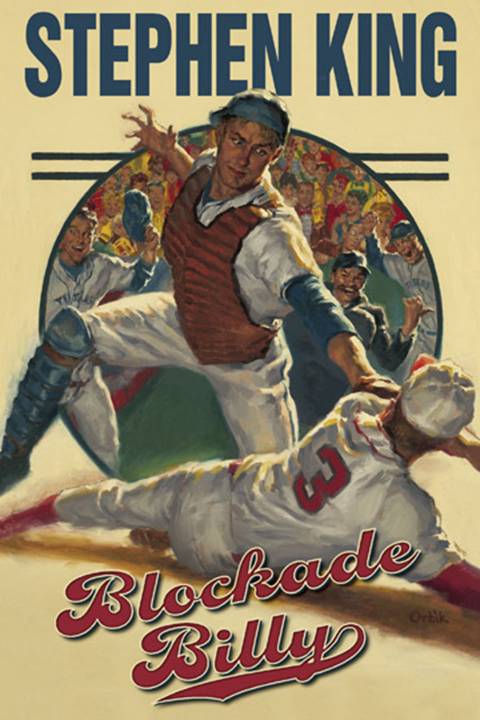 I stumbled upon what I'm hoping is a little gem at the West Wyandotte Public Library this week. It's a fairly new novella from Stephen King called "Blockade Billy." According to the novel's Wikipedia page, King wrote the baseball story in only two weeks.
Pretty impressive, even for a short, short novella.
The last Stephen King novel I reviewed on this blog was the pretty good "The Girl Who Loved Tom Gordon." Although not a baseball novel in subject, baseball plays a part of the backstory.
In "Blockade Billy," King puts baseball center stage.
Right now I'm finishing up Dee Brown's brilliant and enraging "Bury My Heart at Wounded Knee." After that, I'll read and review "Blockade Billy." The reading part should only take me a couple days.
One last note: I know he's Stephen King and everything, but I was a little astonished by the cover price of the tiny hardcover edition of the book. Twenty-five bucks.
I can't imaging paying $25 for a book that's about the length of a magazine article.
But people will pay any price for a book with that man's name on it.
--Matt Kelsey
Friday, June 18, 2010
All Star Game, baby!
This comes as no real surprise, but Kauffman Stadium will be hosting the 2012 MLB All-Star Game.
I'm going to do my darnedest to get tickets, at least to the Home Run Derby, but I'm not going to hold my breath. However, this is pretty exciting for Kansas City, and great for the Royals - and hopefully by 2012 we'll have a team worthy of All-Star designation.
Of course, this won't be Kansas City's first All-Star game. We hosted in 1973, and if you've followed this All-Star story at all, you know that 17 - seventeen - players from that 1973 game are now in the Hall of Fame, including...
Hank Aaron
Tom Seaver
Johnny Bench
Nolan Ryan
Carl Yastrzemski
Catfish Hunter
Carlton Fisk
Brooks Robinson
...just to name a few. Pete Rose was also there. And another ballplayer you may have heard of: Willie Mays, in his final All-Star appearance.
Who will be the Hall of Famers from the 2012 game? I'm guessing the number will probably be less than 17.
Derek Jeter will probably be there. He's a lock for the Hall. Mariano Rivera, if he's still playing. Alex Rodriguez, if the steroid stigma will allow him entry into the Hall. And that's just from the Yankees.
But after that, the Hall of Fame prospects get a little thinner. JAlbert Pujols? Yeah, probably, if he can avoid the steroid speculation. Joe Mauer? Yeah, if he keeps hitting the way he's hitting. Ichiro? Maybe, but he might not have the career numbers to do it (although he already has over 2,000 hits in nine-plus years). Roy Halladay? Tim Lincecum? Zack Greinke? Any number of pitchers in the game today could string together five or six strong seasons and be considered for Cooperstown.
Then there are a lot of borderline position players who may or may not be Hall of Fame worthy. David Wright, Chase Utley, Dustin Pedroia, Miguel Cabrera, guys like that.
Who knows? But it'll be a lot of fun to watch. Can't wait until 2012.
--Matt Kelsey
I'm going to do my darnedest to get tickets, at least to the Home Run Derby, but I'm not going to hold my breath. However, this is pretty exciting for Kansas City, and great for the Royals - and hopefully by 2012 we'll have a team worthy of All-Star designation.
Of course, this won't be Kansas City's first All-Star game. We hosted in 1973, and if you've followed this All-Star story at all, you know that 17 - seventeen - players from that 1973 game are now in the Hall of Fame, including...
Hank Aaron
Tom Seaver
Johnny Bench
Nolan Ryan
Carl Yastrzemski
Catfish Hunter
Carlton Fisk
Brooks Robinson
...just to name a few. Pete Rose was also there. And another ballplayer you may have heard of: Willie Mays, in his final All-Star appearance.
Who will be the Hall of Famers from the 2012 game? I'm guessing the number will probably be less than 17.
Derek Jeter will probably be there. He's a lock for the Hall. Mariano Rivera, if he's still playing. Alex Rodriguez, if the steroid stigma will allow him entry into the Hall. And that's just from the Yankees.
But after that, the Hall of Fame prospects get a little thinner. JAlbert Pujols? Yeah, probably, if he can avoid the steroid speculation. Joe Mauer? Yeah, if he keeps hitting the way he's hitting. Ichiro? Maybe, but he might not have the career numbers to do it (although he already has over 2,000 hits in nine-plus years). Roy Halladay? Tim Lincecum? Zack Greinke? Any number of pitchers in the game today could string together five or six strong seasons and be considered for Cooperstown.
Then there are a lot of borderline position players who may or may not be Hall of Fame worthy. David Wright, Chase Utley, Dustin Pedroia, Miguel Cabrera, guys like that.
Who knows? But it'll be a lot of fun to watch. Can't wait until 2012.
--Matt Kelsey
Subscribe to:
Posts (Atom)